
Sports Betting Psychology: Mastering the Mental Game
 Available in US
Learn to master your mindset, overcome cognitive biases, and avoid the emotional traps that destroy bankrolls with our guide to sports betting psychology.
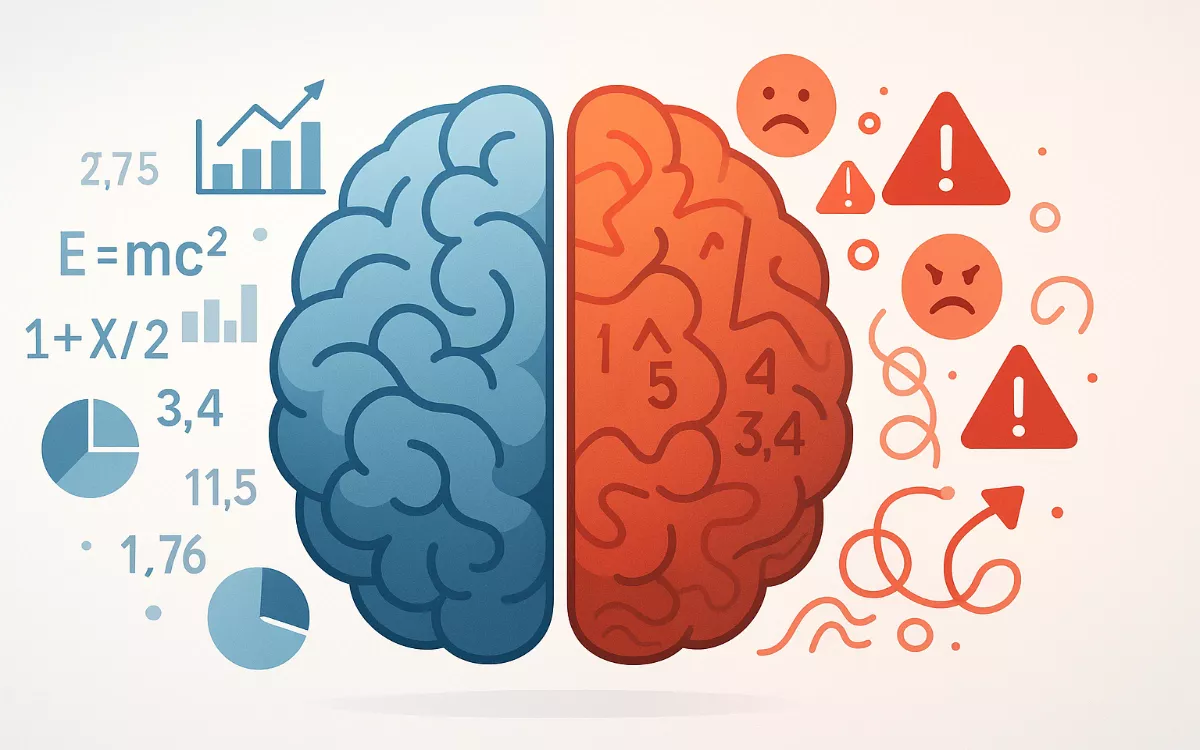
To succeed long-term, mastering sports betting psychology is non-negotiable. You can have the sharpest handicapping skills in the world, the most sophisticated models, and perfect bankroll management on paper. None of it matters if you can’t control your brain. Sports betting isn’t just a test of analytical ability. It’s a psychological gauntlet designed to exploit every cognitive bias, emotional weakness, and irrational impulse humans possess. The sportsbooks don’t need you to be bad at picking games. They just need you to be human.
The cruel irony of sports betting is that the skills required to succeed are exactly opposite to human nature. We’re wired to chase losses, overweight recent events, see patterns in randomness, and make decisions based on emotion rather than logic. Every instinct you have as a human being is pushing you toward bad betting decisions. The bettors who win long-term aren’t smarter or more knowledgeable than everyone else. They’re just better at recognizing and controlling these psychological traps.
This isn’t a lecture about discipline and responsibility, though both matter. This is about understanding the specific ways your brain will sabotage you and developing concrete strategies to prevent it. Most bettors never address the psychological component of betting because they don’t think it applies to them. They think they’re rational. They think they make decisions based on analysis. They’re wrong. Everyone is subject to these biases, and pretending you’re not is the first step toward losing money you could have protected.
Table of Contents
The Dopamine Trap and Why Winning Feels So Good

When you win a bet, your brain releases dopamine. This isn’t metaphorical. It’s literal neurochemistry. The same reward pathways that activate when you eat good food, have sex, or do drugs light up when you win money. This feels amazing, which is the problem. Your brain starts associating betting with pleasure, and like any pleasurable activity, it wants more.
The issue isn’t that winning feels good. The issue is that the pleasure you get from winning distorts your decision-making for future bets. After a big win, you feel invincible. You’re on a hot streak. You’ve figured something out. Your analysis is dialed in. These feelings have nothing to do with reality, but they feel real, and they influence your behavior in predictable ways.
Post-win overconfidence manifests in several ways. You start betting on more games because you want to capitalize on your hot streak. You increase your bet sizes because you’re feeling good and the extra money in your account makes bigger bets seem reasonable. You become less rigorous in your analysis because your recent success suggests your instincts are working. All of these adjustments are mistakes, but your dopamine-soaked brain can’t see that in the moment.
The randomness of sports means you can make terrible decisions and win anyway. When this happens, your brain registers the win as validation of your process. You made an impulsive bet with no real edge and it hit, so clearly your instincts are good and you should trust them more. This is exactly backwards, but it’s how neural pathways get reinforced. Your brain doesn’t distinguish between lucky wins and earned wins. It just knows that action led to reward, and it wants more of that action.
Chasing the high becomes a real problem for some bettors. They’re not betting to make money anymore. They’re betting because the act of having action and potentially winning triggers that dopamine response. The actual outcome becomes almost secondary to the thrill of being in the game. This is when sports betting crosses from hobby into something more concerning, and most people don’t recognize it’s happening until they’re deep in the hole.
The variance in sports betting makes this worse. Unlike slot machines where you lose consistently, sports betting gives you wins frequently enough to keep that dopamine flowing. You’re not just chasing a memory of winning like a losing slots player. You’re getting regular reinforcement that betting feels good. Your brain doesn’t care that you’re net negative on the month. It remembers the high from yesterday’s win more vividly than the accumulated losses.
Breaking the dopamine trap requires conscious awareness of what’s happening. You need to recognize when you’re making decisions based on how winning felt rather than on actual analysis. The best bettors develop routines and checklists that they follow regardless of recent results. They bet the same way after winning as they do after losing. The process stays constant even when emotions are screaming at them to deviate from it.
Some bettors find it helpful to deliberately wait after a win before placing their next bet. Take a day off. Let the emotional high dissipate. Come back to your analysis with clearer judgment. This sounds simple, but it’s incredibly difficult in practice because your brain is telling you the exact opposite. It’s telling you to strike while you’re hot, to keep the momentum going, to make another bet right now. Learning to recognize and ignore that voice is a skill that takes practice.
Loss Aversion and the Pain of Losing

If winning triggers dopamine, losing triggers something worse. Loss aversion is the psychological principle that losses hurt more than equivalent gains feel good. Losing $100 feels worse than winning $100 feels good. This isn’t a matter of opinion or personality. It’s been demonstrated repeatedly in psychological research. Humans are wired to experience losses as more psychologically painful than gains are pleasurable.
In betting, this creates obvious problems. When you lose a bet, the emotional pain is intense. Your brain is screaming at you that you need to fix this, that you need to get that money back, that you can’t just accept the loss. This is where tilt begins. Tilt is the state of making increasingly irrational decisions driven by emotion rather than logic, and it’s the single fastest way to destroy a betting bankroll.
The immediate post-loss period is when most bad decisions happen. You just lost a bet, maybe a frustrating bad beat where everything went wrong at the last second. You’re angry, you’re frustrated, and you have a burning need to get back to even. So you immediately make another bet, usually larger than your standard unit size, on a game you haven’t properly analyzed. This bet often loses too, because you made it emotionally, which compounds the problem and sends you deeper into tilt.
Chasing losses is the classic manifestation of loss aversion run amok. You’re down $200 on the day, so you make a $200 bet to try to get back to even. When that loses, you’re down $400, so now you need to bet even more. The math becomes increasingly insane but the emotional logic feels airtight. You can’t end the day as a loser. You need to get back to even. Before you know it, you’ve blown through a week’s worth of bankroll in a single afternoon of tilted betting.
What makes this particularly insidious is that occasionally chasing losses works. You get lucky, the bet hits, and you get back to even or close to it. This random reinforcement is incredibly powerful. Your brain logs this as success and makes you more likely to chase losses in the future. The fact that chasing loses nine times out of ten doesn’t matter to your dopamine system. It remembers the one time it worked and wants to recreate that experience.
The pain of losing also affects your risk tolerance in unhealthy ways. When you’re losing, you become more willing to take bigger risks to try to recover. When you’re winning, you become more conservative to protect your gains. This is exactly backwards from optimal decision-making. Your bet sizing and risk tolerance should be based on bankroll and edge, not on whether you’re currently up or down. But loss aversion makes you bet bigger when you can least afford it and smaller when you should be pressing your advantage. Understanding your mindset is just as crucial as mastering proper sports betting bankroll management to ensure long-term profitability.
Bad beats hit differently than regular losses. When you lose because your analysis was wrong, that’s one thing. When you lose because of a fluke last-second play that had nothing to do with the quality of your bet, that’s rage-inducing. Your brain categorizes this as unfair, which triggers even stronger emotional responses. You were right and you lost anyway, which feels like an injustice that needs to be corrected. This is a trap. The universe doesn’t owe you anything, and betting more to compensate for bad luck is how you turn bad luck into catastrophic losses.
Dealing with loss aversion requires developing emotional regulation skills that don’t come naturally. You need to accept that losing is part of betting and doesn’t require immediate correction. You need to take breaks after losses instead of immediately trying to win the money back. You need to have hard stop-loss rules that force you to quit for the day when losses hit a certain threshold, and you need the discipline to actually follow those rules when every fiber of your being is telling you to keep betting.
The best approach is divorcing your emotional state from short-term results entirely. This is easier said than done, but it’s achievable with practice. You need to train yourself to evaluate bets based on process rather than outcome. Did you follow your analysis methodology? Did you identify genuine value? Did you bet the appropriate amount? If yes to all three, then the bet was correct regardless of whether it won or lost. That won’t make losses feel good, but it can make them feel less personal and less like something you need to immediately avenge.
Confirmation Bias and Seeing What You Want to See
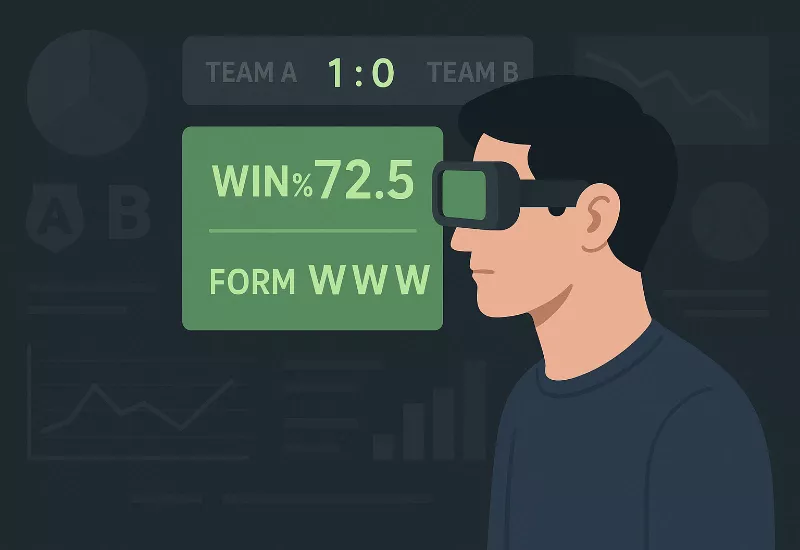
Humans don’t process information objectively. We filter everything through our existing beliefs and biases, giving more weight to information that confirms what we already think and dismissing information that contradicts it. This is confirmation bias, and it’s absolutely lethal in sports betting.
Here’s how it plays out. You want to bet on Team A, maybe because you like them, maybe because you have a hunch, maybe for no particular reason at all. So you start researching the game. But you’re not actually researching objectively. You’re looking for reasons that support betting on Team A. When you find stats that make Team A look good, you note them carefully. When you find stats that make Team A look bad, you rationalize them away or ignore them entirely.
By the time you’re done with your “research,” you’ve convinced yourself that Team A is a great bet. You have a whole list of reasons why they’re going to cover. What you don’t have is an objective assessment of the game, because you never actually looked at it objectively. You started with a conclusion and worked backwards to find support for it. This isn’t analysis. It’s rationalization pretending to be analysis.
The dangerous thing about confirmation bias is that it feels like you’re being thorough. You did research. You have reasons for your bet. You can articulate why you think Team A will win. But all of that is worthless if you never genuinely considered the opposing viewpoint. If you never seriously asked yourself whether Team B might actually be the better bet, you’re not making an informed decision. You’re just finding sophisticated-sounding ways to justify what you already wanted to do.
This shows up particularly strongly with favorite teams and favorite players. If you’re a lifelong fan of the Cowboys, your ability to objectively assess Cowboys games is compromised. When you look at a game involving Dallas, you’re going to unconsciously weight positive information more heavily and dismiss negative information. You’ll find yourself making excuses for concerning trends and amplifying positive indicators. You think you’re being objective because you’re looking at stats, but your emotional attachment is biasing which stats you take seriously.
Narratives are another vector for confirmation bias. Sports media constantly generates narratives about teams and players. This team is hot, that team is imploding, this coach is a genius, that quarterback is washed. These narratives are sticky. Once you’ve absorbed them, you start seeing everything through that lens. You notice plays that support the narrative and ignore plays that contradict it. If the narrative says a team is mentally tough, you interpret close wins as proving it. If the narrative says they’re chokers, you interpret close wins as lucky. Same facts, different interpretations based on the story you’ve already bought into.
Social media amplifies confirmation bias by creating echo chambers. If you follow betting accounts that align with your views, you’ll see constant reinforcement of your opinions. Everyone seems to agree with you, which makes you more confident you’re right. But you’re not seeing a representative sample of betting opinion. You’re seeing a curated feed of people who think like you. This false consensus makes you more certain of positions that might be completely wrong.
The hardest part of dealing with confirmation bias is accepting that you can’t fully eliminate it. You can manage it, you can be aware of it, you can develop processes to counteract it, but you can’t make yourself perfectly objective. Your brain doesn’t work that way. The goal is to minimize confirmation bias enough that it doesn’t systematically tank your results, not to achieve some impossible state of pure rationality. Recognizing you’re biased is half the battle. Most bettors never get even that far.
Recency Bias and the Hot Hand Fallacy
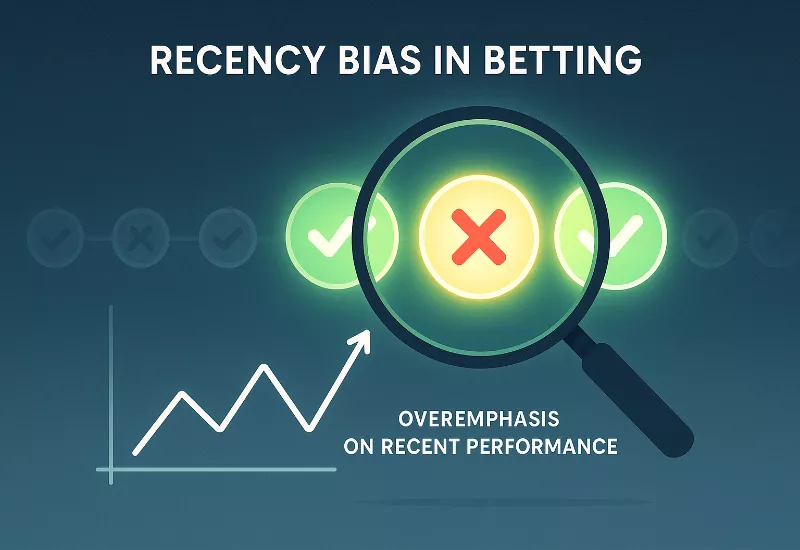
Humans have terrible intuition about randomness and probability. We see patterns where none exist. We think recent events are more predictive of future events than they actually are. In betting, this manifests as recency bias and hot hand fallacy, and both are profit-killers.
Recency bias is the tendency to overweight recent information relative to older information. A team wins three games in a row and suddenly everyone thinks they’re great. The market adjusts, often overcorrecting, which creates value on the other side. But most bettors don’t see the overcorrection. They see a team that’s won three straight and they want to bet on them because hot teams win. Never mind that the underlying metrics suggest those wins were fluky. Never mind that the competition was weak. Three wins in a row feels meaningful, so it must be meaningful.
The market is susceptible to recency bias too, which is why line moves often overreact to recent performance. When a team wins big in Week 8, their Week 9 line moves significantly even if nothing fundamental about the team changed. The public piles on, the bookmakers shade the line to account for public sentiment, and suddenly you have a team priced based on one impressive performance rather than the full body of their season. This creates opportunities for contrarian bettors who can look past the recency and assess true team quality.
Hot hand fallacy is related but distinct. It’s the belief that success breeds success, that players or teams can be “hot” in ways that make them more likely to keep succeeding beyond what their underlying skill would predict. The classic example is a basketball player who makes three shots in a row and everyone thinks he has the hot hand, he’s feeling it, he should keep shooting. Research shows this is mostly illusion. The made shots don’t actually predict the next shot will go in at a higher rate than normal.
In betting, hot hand fallacy shows up when bettors think they’re on a hot streak. You hit three bets in a row and suddenly you feel like you’re dialed in. You can’t miss. You should bet more because your analysis is clearly working. This is nonsense. Three bets is an incredibly small sample size. You could flip a coin three times and get heads every time. That doesn’t mean the fourth flip is more likely to be heads. But your brain desperately wants to believe in momentum and patterns, so it interprets random short-term success as meaningful.
The opposite happens after losing streaks. You lose three bets in a row and you start questioning everything. Maybe your process is broken. Maybe you don’t know what you’re doing. Maybe you should stop betting for a while. But three losses is also an incredibly small sample. Even if you’re betting at 55% win rate—which is great—you’ll lose three in a row regularly just from normal variance. Treating this as meaningful and adjusting your approach based on it is exactly wrong.
Counteracting recency bias requires forcing yourself to look at larger sample sizes. One game is meaningless. Three games is barely better. You need to look at full seasons, multiple seasons, and context-adjusted performance to get a real sense of team quality. This is hard because recent games are fresh in your mind and easier to recall. You remember what happened last week vividly. What happened in Week 2 is fuzzy. But Week 2 information is just as relevant as Week 8 information for predicting Week 9 performance.
Creating systems and rules helps. If you have a model or a process you follow consistently, you’re less likely to get swayed by recent results. The model doesn’t care that Team A won three in a row. It just processes the inputs and spits out an output. This doesn’t mean you should follow your model blindly, but it does mean having some kind of systematic approach protects you from the recency bias that your unassisted brain will naturally exhibit.
Sample Size Understanding and Variance Tolerance
Most bettors fundamentally misunderstand how much variance exists in sports betting outcomes. They think that if they make ten good bets and lose seven of them, something must be wrong. In reality, this is well within normal variance. Even professional bettors with legitimate edges lose 45% of their bets. That means losing seven out of ten happens regularly just from normal statistical distribution.
The human brain is terrible at understanding this intuitively. We want to see patterns and causes. When we lose several bets in a row, we want there to be a reason. Our analysis must be off, or we’re tilting, or we’ve lost our edge. Sometimes that’s true, but often it’s just variance playing out exactly as the math predicts. Runs of losses happen. They don’t require explanation beyond probability.
This is psychologically brutal because humans want immediate feedback. We want to know if we’re doing well or poorly, and we want to know quickly. Sports betting doesn’t work that way. You can do everything right for a month and be down money. You can do everything wrong for two weeks and be up money. Short-term results are mostly noise. The signal only emerges over huge sample sizes that require patience most people don’t have.
Beginner bettors almost universally overestimate how quickly they should be seeing positive results. They read about betting strategy, they make some bets, and they expect to be profitable immediately. When they’re not—because variance is real and edges take time to manifest—they think the strategy doesn’t work or that betting is impossible. They quit before they’ve given their edge, if they have one, time to express itself in results.
Understanding variance should make you more comfortable with losses, not less comfortable. If you make a bet you’ve properly analyzed and identified as +EV, losing that bet should barely register emotionally. You made the right decision. The outcome was just one possible result from a probability distribution, and this time it landed on a loss. That’s fine. Make that same bet a thousand times and you’ll profit. But you need to actually make it a thousand times, which means not getting discouraged by the first hundred losses.
Streaks are inevitable and meaningless. You’ll have periods where you win twelve out of fifteen bets and feel like a god. You’ll have periods where you lose twelve out of fifteen and feel like you should quit. Both streaks can happen to a perfectly break-even bettor just from randomness. The winning streak doesn’t mean you’ve figured something out. The losing streak doesn’t mean you’ve lost your edge. They’re both just what happens when you run probability experiments repeatedly.
Some bettors find it helpful to run simulations to build intuition about variance. Take a coin that’s 55% heads and 45% tails—roughly what a good sports bettor’s win rate looks like. Flip it a hundred times and track how many heads you get. You’ll get anywhere from 45 to 65 heads most of the time. The expected value is 55, but you rarely hit exactly 55. Now imagine each flip is a bet. This helps you visualize how much normal results can diverge from expectation over realistic sample sizes.
Setting proper expectations before you start betting helps. Know that profitable bettors still lose close to half their bets. Know that losing weeks are common even for sharps. Know that small sample sizes are meaningless. If you go in understanding this, you’re less likely to panic when variance inevitably goes against you. If you go in thinking you should win consistently right away, you’re setting yourself up for disappointment and probably tilt.
Building Mental Frameworks and Discipline Systems

Knowing about psychological biases intellectually doesn’t prevent them from affecting you. Your conscious brain can know you’re experiencing confirmation bias while your unconscious brain continues exhibiting it anyway. The solution isn’t just awareness. It’s building systems and frameworks that counteract your psychological weaknesses regardless of whether you’re consciously recognizing them in the moment.
Pre-bet checklists are incredibly useful for this. Before placing any bet, you go through a written list of questions. Have you analyzed both sides objectively? Have you checked multiple sportsbooks for the best line? Is this bet within your normal unit size? Are you making this bet based on analysis or based on tilt? Having to explicitly answer these questions forces you to slow down and engage your rational brain rather than just clicking the bet button impulsively.
Some bettors implement mandatory waiting periods. If you want to make a bet, you have to wait fifteen minutes first. Write down your reasoning, walk away, do something else, and then come back. If you still think it’s a good bet after the waiting period, make it. If not, don’t. This simple friction prevents impulsive betting driven by emotion rather than analysis. It won’t stop you from making considered but wrong bets, but it will stop you from making unconsidered bets.
Stop-loss limits are non-negotiable for managing tilt. Decide in advance that if you lose X amount in a day or Y amount in a week, you stop betting for a specified period. Maybe losing 5% of your bankroll in one day means you’re done for forty-eight hours. Maybe losing 15% in a month means you take a week off. The specific numbers matter less than having rules you actually follow. When the limit hits, you stop, even if—especially if—every instinct is telling you to keep betting.
Keeping a betting journal helps with pattern recognition over time. Record not just your bets but your mental state when making them. Were you feeling confident, desperate, bored, frustrated? Over time you’ll notice that bets made in certain mental states perform differently. Maybe your desperate bets consistently lose. Maybe your bored bets are actually fine. This data helps you recognize warning signs in the moment. When you notice you’re feeling desperate, you can catch yourself before making a tilt bet.
Having an accountability partner or betting community can provide external checks on your behavior. Someone who knows you’re prone to tilt after losses and will call you out when they see you about to make an emotional bet. This only works if you’re honest with them and if they’re willing to be honest with you, which requires genuine trust and shared goals around betting responsibly.
None of this completely eliminates the psychological challenges of betting. You’re still human, you’re still going to tilt sometimes, you’re still going to exhibit biases. But systems and frameworks reduce the frequency and severity of psychological errors. They give you guard rails that keep you from careening off the road even when your emotional brain is trying to take the wheel. That’s often the difference between long-term success and failure in betting—not being perfect, just being slightly less imperfect than the market expects.
For more comprehensive strategies, return to our top sports betting advice platform to refine your skills.
