
How to Find Value Bets in Sports Betting: Expert Methods
 Available in US
Master the art of calculating probability, identifying market inefficiencies, and consistently finding value bets to beat the sportsbooks.
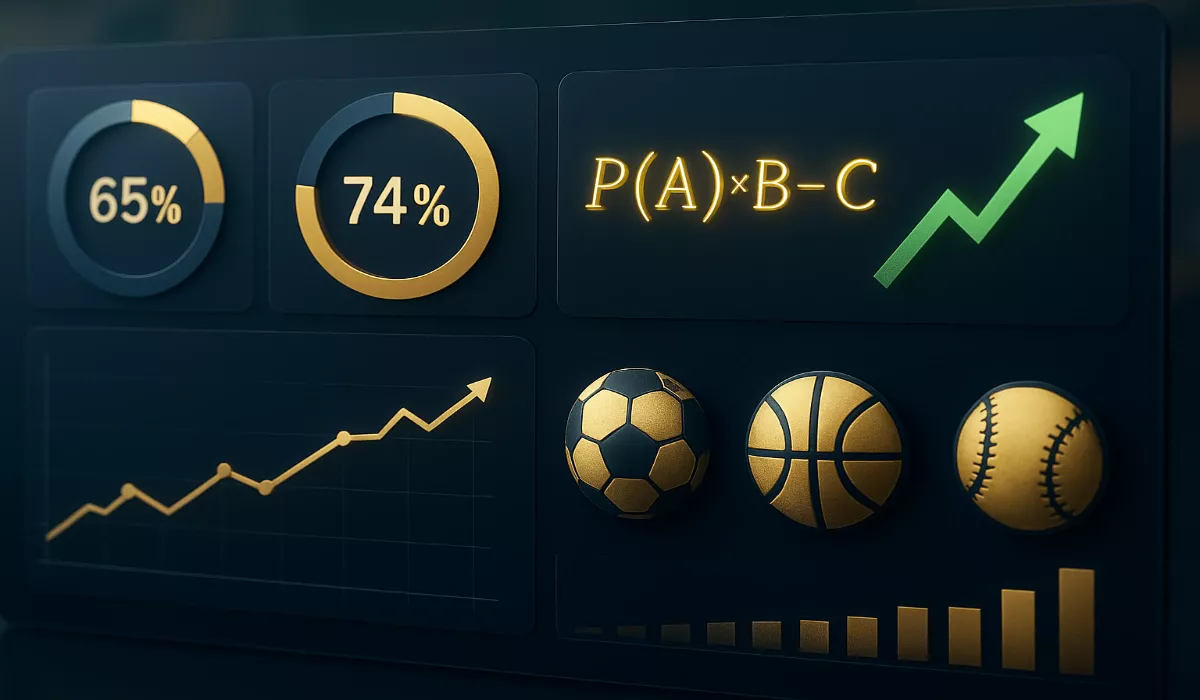
The entire game of profitable sports betting boils down to one concept: finding value bets. Not picking winners. Not having the hottest takes. Not even being right more often than you’re wrong. Value is the only thing that matters, and most bettors spend their entire betting careers without truly understanding what it means or how to find it.
Here’s the thing that trips people up. You can pick the winner of a game and still make a bad bet. You can pick the loser and still make a good bet. This sounds contradictory until you understand that betting isn’t about outcomes, it’s about prices. A bet has value when the odds you’re getting are better than the true probability of that outcome happening. Everything else is just noise.
Professional bettors don’t ask themselves “who’s going to win this game?” They ask “what’s the probability this team wins, and are the odds I’m getting better than that probability suggests they should be?” That’s the fundamental shift in thinking that separates people who make money from people who donate to sportsbooks. You’re not trying to predict the future. You’re trying to find spots where the market has mispriced the future, and you’re taking advantage of that mispricing.
This guide is about teaching you how to think about probability, how to identify market inefficiencies, and how to consistently find bets where you’re getting better odds than you should. It’s not easy. The market is reasonably efficient, especially for major sports. But inefficiencies exist, and with the right approach and enough work, you can find them often enough to make a real difference in your results.
Table of Contents
Understanding True Probability vs Implied Probability
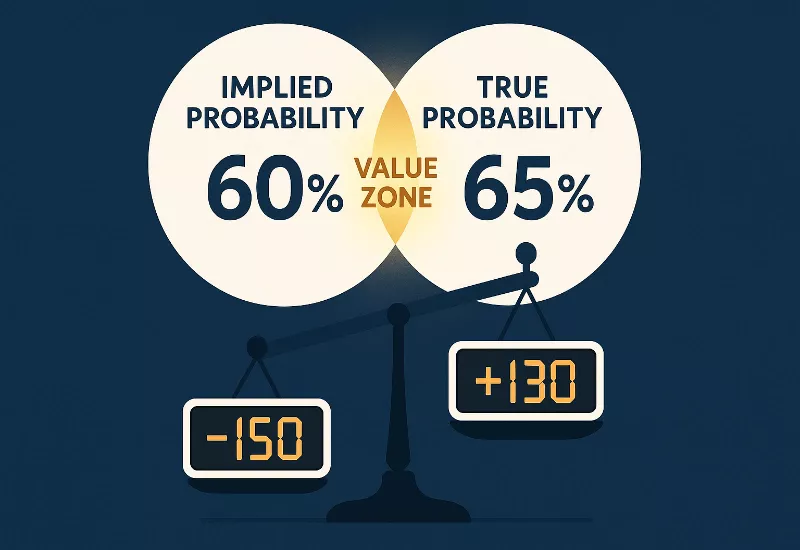
Before you can identify value, you need to understand the relationship between odds and probability. Every set of betting odds implies a probability of that outcome occurring. When you see a team at -150 on the moneyline, that’s not just a random number. It’s the sportsbook saying they believe that team has a certain probability of winning, and they’ve converted that probability into odds.
Implied probability is calculated by taking the odds and working backwards to figure out what win percentage they represent. For American odds, the math is different for favorites and underdogs. For favorites, you divide the odds by the odds plus 100. So -150 becomes 150 / (150 + 100) = 150 / 250 = 60%. The sportsbook is implying that team has a 60% chance of winning. For underdogs, you divide 100 by the odds plus 100. So +130 becomes 100 / (130 + 100) = 100 / 230 = 43.5%.
The catch is that if you calculate the implied probabilities for both sides of a bet and add them up, they don’t equal 100%. They equal something like 105% or 108%. That extra percentage is the vig, the house edge, the sportsbook’s cut. This is how they make money regardless of which side wins. They’re not trying to predict the winner, they’re trying to balance action and guarantee themselves a profit.
True probability is your assessment of how likely an outcome actually is. This is where your research, your models, your expertise comes in. You’re trying to determine what you believe the real chance of something happening is, independent of what the odds say. If you think a team has a 65% chance of winning but they’re priced at odds that imply only 60%, you’ve potentially found value. Identifying these market inefficiencies is nearly impossible without conducting thorough sports betting research on a daily basis.
The gap between implied probability and true probability is where value lives. When your assessed probability is higher than the implied probability, you have a positive expected value bet. When it’s lower, you have negative expected value. Over time, making positive EV bets will make you money even if many individual bets lose. Making negative EV bets will lose you money even if many individual bets win.
This is why betting favorites at bad odds is such a trap for recreational bettors. They’re right more often than wrong, which feels good and reinforces the behavior. But they’re getting such bad value on their bets that even with a high win rate, they’re losing money over time. They’re laying -250 to bet on heavy favorites, which means they need to win 71.4% of the time just to break even. If they’re only winning 65%, they feel successful because they’re winning most of their bets, but mathematically they’re getting crushed.
The hardest part about all this is that you never know for certain what the true probability of anything is. Sports aren’t dice rolls with known probabilities. You’re always making estimates based on incomplete information. The goal isn’t to calculate exact probabilities, which is impossible. The goal is to develop a framework for estimating probabilities that’s more accurate than the market’s estimate often enough to create an edge.
Developing Your Own Probability Assessments

So how do you actually determine what you think the true probability of something is? This is the work of handicapping, and it’s where most of the actual effort in sports betting happens. There’s no universal system because different bettors have different strengths and different sports require different approaches. But there are principles that apply across the board.
Start by understanding that you need some kind of model or framework. You can’t just go with your gut. Intuition is useful, but only when it’s informed by systematic analysis. The sharps who make real money have processes they follow consistently. Those processes might be sophisticated computer models, they might be detailed spreadsheets with dozens of factors, or they might be relatively simple heuristics based on years of pattern recognition. But they’re processes, not vibes.
The simplest approach is to start with the market consensus and then adjust based on information you have that the market doesn’t or factors you believe the market is mispricing. The closing line in sports betting is generally pretty sharp because it reflects the accumulated wisdom of thousands of bettors and millions of dollars of action. Thinking you can consistently beat the closing line without a real edge is naive. But thinking the closing line is perfect is equally wrong. There are spots where it’s wrong, and finding those spots is the game.
One common approach is to build your own power ratings for teams. You assign each team a number representing their strength, and then you can calculate what you think the spread should be for any matchup by taking the difference between the ratings and adjusting for home field advantage. If your number differs significantly from the market number, you might have found value. The challenge is building power ratings that are actually more accurate than the market’s implied ratings, which is harder than it sounds.
For individual game analysis, you want to look at factors that genuinely predict outcomes and aren’t already fully priced into the line. Recent form matters, but everyone knows about recent form. The market adjusts for it, often aggressively. If a team just won three straight games, the odds on their next game already reflect that. You’re not getting an edge by betting them because they’re hot. You might get an edge if you can determine that those three wins were fluky and they’re actually not as good as the market now thinks they are.
Matchup-specific factors are often more exploitable than general team strength. How does this offense match up against this defense stylistically? Are there specific weaknesses that align with specific strengths? A team that struggles defending the pass but is great against the run is in trouble against a pass-heavy offense, but the market might not fully adjust if that pass-heavy offense hasn’t been putting up huge numbers lately. These kinds of nuanced matchup advantages are where you can sometimes find inefficiencies.
Situational spots can create value when the market overreacts or underreacts. A team coming off an emotional win in a rivalry game might be flat in their next game. A team that’s locked up a playoff spot might not be fully motivated. A team facing a must-win situation might play above their talent level. These situations matter, but you have to be careful because the market is also aware of these narratives and prices them in. The key is figuring out when the market has overpriced or underpriced the situational angle.
You also need to understand the limits of your knowledge. If you’re betting NFL, you might have genuine expertise in that area. That doesn’t mean you should bet NBA with the same confidence. The more specialized your knowledge, the more likely you are to have an edge. The sharps who crush sports betting aren’t generalists betting everything. They’re specialists who’ve put in thousands of hours studying one or two sports and know more about those specific areas than the general market does.
Building your own probability assessments is iterative. You make a prediction, you see what happens, you compare your prediction to both the outcome and to how the market moved. Over time, you start to recognize patterns in where you’re systematically too high or too low. Maybe you consistently undervalue home underdogs in division games. Maybe you overvalue teams coming off blowout wins. These patterns only become visible if you’re tracking everything and analyzing your results, but they’re gold when you find them.
Identifying Market Inefficiencies
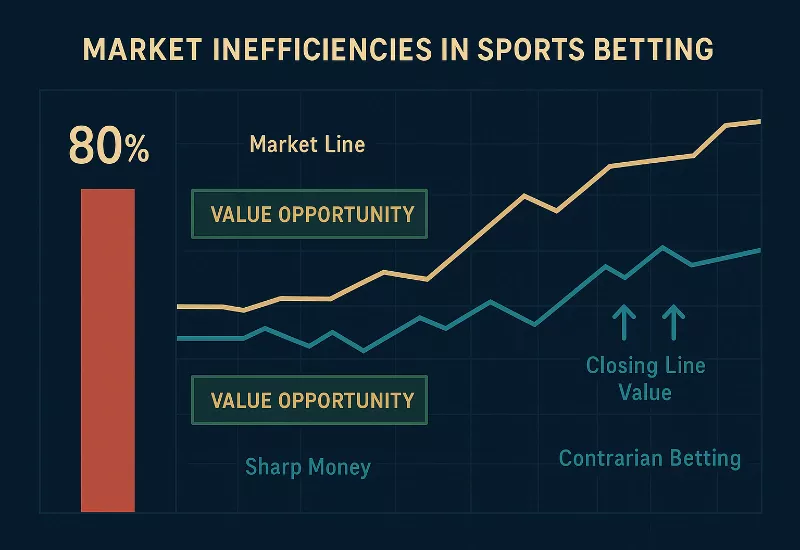
The market for sports betting is reasonably efficient, meaning prices generally reflect true probabilities pretty well. But reasonably efficient isn’t perfectly efficient, and the gaps are where value lives. Understanding where inefficiencies commonly occur gives you a roadmap for where to focus your attention.
Public bias is one of the most reliable sources of inefficiencies. Recreational bettors tend to bet with their hearts and their biases rather than with cold analysis. They bet on favorites because betting on favorites feels safer. They bet on teams that won recently because those teams feel hot. They bet on popular teams because those are the teams they know and follow. This creates systematic overvaluation of certain sides and undervaluation of others.
When public money piles heavily onto one side of a game but the line doesn’t move much or actually moves the other direction, that’s often a sign that sharp money is taking the less popular side. The sportsbooks know that the sharp bettors are more likely to be right, so they’re willing to take a lopsided public position as long as the sharps are on the other side providing balance. This is called “fading the public,” and it works because the public is wrong in predictable ways.
Recency bias affects both the public and sometimes even the market itself. A team that just played terribly is often undervalued in their next game if that poor performance was uncharacteristic. A team that just dominated is often overvalued if that performance was an outlier. The market tends to overweight recent results, especially dramatic ones, which creates opportunities if you can determine when recent performance doesn’t actually indicate a meaningful change in true team quality.
The flip side is that closing line value is a strong indicator of whether you’re finding value. If you consistently bet a side and then the line moves in your direction before kickoff, that’s the market validating your opinion. You’re betting on the same side the sharps are betting, which means you’re probably right about value. If the line consistently moves against you, that’s the market telling you you’re wrong. Tracking your CLV over time is one of the best ways to know if your process for finding value is actually working.
Line Shopping and Odds Comparison
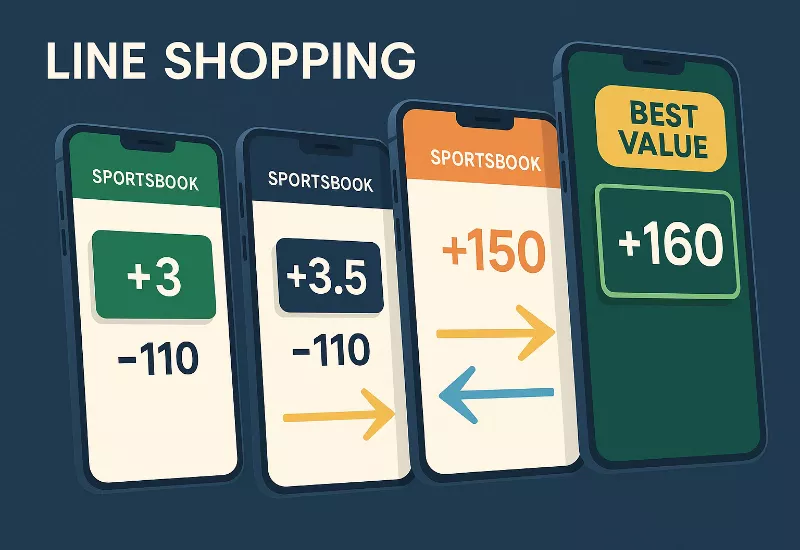
One of the simplest ways to create value doesn’t require you to be better at handicapping than anyone else. You just need to check multiple sportsbooks and take the best available price. This is called line shopping, and it’s shocking how many bettors don’t do it consistently.
Different sportsbooks will have different lines on the same game. Sometimes the difference is small, half a point on the spread or a few cents on the odds. Sometimes it’s larger, a full point or more. These differences exist because each book has different customer bases, different risk management approaches, and different opinions on where the line should be. What matters for you is that getting the best available line dramatically improves your long-term results.
Let’s say you want to bet on a football underdog. At one book they’re +3 at -110. At another book they’re +3.5 at -110. That half point might not seem like much, but it’s enormous. Games land on 3 constantly in football. If you take +3 and the favorite wins by exactly 3, you push. If you took +3.5, you win. Over hundreds of bets, these half points add up to a massive difference in profitability.
The same applies to moneyline odds. One book might have an underdog at +150, another at +160. You’re betting on the same outcome, the exact same probability in your opinion, but one bet pays you $10 more per $100 wagered. If you’re making this bet and you take +150 instead of +160, you’ve thrown away value for no reason. It’s like negotiating a raise at work and then not taking the higher offer.
Line shopping requires having accounts at multiple sportsbooks, which means dealing with the overhead of managing multiple accounts, multiple deposits, multiple withdrawals. It’s a pain, but it’s worth it. If you’re serious about making money betting sports, this isn’t optional. The difference between having one account and having five or six accounts where you can compare lines is the difference between being a breakeven bettor and a profitable one.
The practical reality is that you won’t always be able to get the absolute best line. Sometimes the best line is at a book where you’re limited or where you don’t have an account. Sometimes the best line disappears by the time you try to place the bet. But even catching the best line 70% or 80% of the time is a massive edge. You’re systematically getting better prices than bettors who just log into their favorite book and bet whatever line is there.
The bottom line on line shopping is that it’s one of the few things in sports betting that’s actually free money. You’re not taking on any additional risk. You’re not betting any more often. You’re just systematically getting better prices on bets you were going to make anyway. If you’re not doing this, you’re leaving significant money on the table over time.
Using Data and Models Effectively
Sharp bettors increasingly use data-driven approaches and statistical models to find value. This doesn’t mean you need a PhD in statistics or that you need to build some complex algorithm. But understanding how to use data effectively is important.
The first rule of using data is to focus on data that actually predicts outcomes. Sports analytics has exploded over the last decade, and there’s more information available than ever. The problem is that most of it is either noise or already fully priced into the market. You need to find data points that give you an edge, not just data points that are interesting.
Simple box score stats are usually not enough. Everyone can see points per game, yards per attempt, field goal percentage. The market knows this information and has already adjusted for it. What you’re looking for is either data that’s not widely available or insights derived from public data that most people aren’t extracting. This might be advanced metrics, it might be matchup-specific analysis, or it might just be doing better fundamental analysis than the average bettor.
Historical trends can be useful but only if they’re genuinely predictive and not just correlation that looks like causation. You’ll see stuff like “teams off a bye week are 65% against the spread in divisional games” and people treat that as meaningful. But is it? What’s the sample size? Is it actually predictive going forward or just a historical quirk? Most trends like this are noise, but occasionally you find patterns that reflect genuine underlying dynamics.
Building your own models is an option if you have the skills and inclination. The goal isn’t to build something more sophisticated than what the sportsbooks use, which would be nearly impossible. The goal is to build something that captures some angle or emphasis that’s different enough from the market’s approach that it sometimes produces different results. When your model disagrees with the market, that’s not automatically value, but it’s a signal worth investigating.
The analytics revolution in sports has made some aspects of betting harder because sportsbooks have access to better data and better models than they used to. But it’s also made betting more accessible to people willing to put in the work. You can build sophisticated analysis tools with free or cheap software, access to massive databases of historical results, and publicly available advanced metrics. The barriers to entry for serious sports betting analysis are lower than they’ve ever been.
Psychological Aspects of Value Betting

Finding value isn’t just about math and data. It’s also about psychology, both in terms of understanding market psychology and managing your own psychology.
The market is driven by human behavior, which means it’s subject to all the biases and irrationalities that humans exhibit. Understanding these biases helps you predict where the market is likely to be wrong. The public overvalues favorites, so there’s often value on underdogs. The public overreacts to recent performance, so there’s value on teams coming off bad games that aren’t actually as bad as they looked. The public bets with their hearts, so there’s value betting against popular teams when the matchup doesn’t favor them.
But you’re also human, which means you’re subject to the same biases. One of the hardest things about value betting is taking bets that feel uncomfortable. Value often exists on sides that the public is avoiding, which means you’re betting on teams that just lost badly, teams that are unpopular, teams that nobody wants to bet on. It’s psychologically easier to bet on winners, bet on popular teams, bet on favorites. Doing the opposite requires genuine mental discipline.
You also have to deal with the fact that value betting doesn’t mean winning betting, at least not in the short term. You can make a bet that’s absolutely +EV, lose it, and know you made the right decision. You can make ten +EV bets and lose seven of them. Variance is brutal over small samples. This is incredibly hard to accept emotionally. Every loss feels like maybe you were wrong, maybe you don’t actually have an edge, maybe you should change your approach.
The emotional attachment to being right is another trap. When you make a prediction and bet on it, you’ve taken a public position on what you think will happen. When that bet loses, it’s not just money lost, it’s being wrong. For some people, that’s psychologically more painful than the money. This leads to doubling down on bad positions, refusing to admit when analysis was off, and generally making betting decisions for ego reasons rather than EV reasons.
Value betting also requires patience that most people don’t have. There will be days where you don’t find any value. Days where every game you look at seems fairly priced and there’s nothing to bet. The recreational bettor forces action anyway because they’re bored or because it’s Sunday and games are on. The professional bettor is perfectly comfortable not betting. They’d rather make no bet than a bad bet. This patience is hard to maintain, especially when you’re watching games and wishing you had action.
Finally, there’s the challenge of staying disciplined about bet sizing. When you find a bet you think has huge value, the temptation is to bet more than your standard unit size. Sometimes that’s appropriate, but usually the edge you think you have isn’t as big as you think it is. Overconfidence leads to oversized bets, which leads to accelerated bankroll damage during the inevitable times you’re wrong. Value betting is about finding small edges and exploiting them consistently, not about making huge bets on perceived locks.
Practical Value Betting Strategies
So how do you actually implement value betting in practice? Here are some strategies that work for finding and exploiting value in different contexts.
For pregame betting, start by developing a routine for analyzing games. Don’t just bet on whatever catches your attention. Have a systematic process for identifying potential value. Maybe you screen for games where there’s a large discrepancy between opening and current line, which might indicate sharp opinion. Maybe you look for games where your power ratings differ significantly from the market number. Maybe you focus on specific situational angles you’ve identified as profitable. Whatever your system, it should be consistent and repeatable.
Contrarian betting is a straightforward value strategy. When everyone is betting one side, there’s often value on the other side. This doesn’t mean blindly betting against the public, but it means being more interested in analyzing the unpopular side. If 80% of bets are on Team A, really dig into whether Team B might be undervalued. The market might be right, but it’s also might be overreacting to public opinion.
Specialization is one of the best ways to develop an edge. Instead of betting everything, pick one sport or even one league and become an expert in it. You’ll develop pattern recognition, you’ll know the teams better than the general market, and you’ll spot value that generalists miss. The sharps who make serious money aren’t betting twenty different sports. They’re specialists who know their area better than almost anyone.
Finally, be willing to admit when you’re wrong about a game, a team, or a strategy. If something you thought would create value isn’t actually working, change your approach. The market evolves, teams change, what worked last year might not work this year. Stubbornly sticking to a strategy that’s not producing results is ego, not edge. The best bettors are constantly refining their process based on what the data tells them.
Finding value in sports betting isn’t easy. It requires work, discipline, analytical skills, psychological resilience, and a willingness to think differently than the crowd. But it’s the only sustainable path to profitability. Master the concept of value, learn to identify it consistently, and have the discipline to only bet when you’ve actually found it, and you’ll give yourself a real chance to beat the market over time.
Maximize your returns by following the top betting advice website designed for professional bettors.
