
Bet Advice: Complete Sports Betting Strategy 2026
 Available in US
Master profitable sports betting strategy with our complete guide. Learn bankroll management, value betting, and psychology to beat the sportsbooks in 2026.

The difference between betting for fun and a winning sports betting strategy isn’t what most people think. It’s not about having insider connections or spending twelve hours watching game film. Most recreational bettors lose because they approach sports betting the same way they approach everything else with their gut, their biases, and their favorite teams clouding every decision.
Here’s the uncomfortable truth: sportsbooks aren’t worried about you. They’ve built their entire business around the fact that most people bet with their hearts instead of their heads, chase losses instead of cutting them, and mistake entertainment for investment strategy. The house edge exists in every single bet, and it compounds over time if you’re not strategic about how you bet.
This guide won’t promise you’ll become wealthy by next season. That’s the nonsense that gets people into trouble. What it will do is give you a genuine framework for thinking about sports betting mathematically, psychologically, and practically. You’ll learn why bankroll management matters more than picking winners, why the best bet is often the one you don’t make, and how professional bettors think about value in ways casual bettors never consider.
We’re covering everything from foundational principles to advanced concepts that give sharp bettors their edge. No fluff, no guaranteed systems, no miracle formulas. Just honest, practical advice built on what actually works. If you want get-rich-quick schemes, you’re in the wrong place. But if you want to understand how to approach sports betting with strategic thinking that might actually give you a fighting chance, you’re exactly where you need to be.
Table of Contents
- Why Most Bettors Fail (And How to Avoid Their Mistakes)
- Building Your Betting Foundation: Bankroll Management
- Finding Value: The Core of Profitable Betting
- Research That Actually Matters
- Choosing the Right Bet Type for Your Strategy
- Tailoring Your Approach by Sport
- The Mental Game: Psychology of Successful Betting
- Leveling Up: Advanced Betting Concepts
- Tracking Progress: Why Records Matter
- Red Flags and Traps to Avoid
- Conclusion
- FAQ
Why Most Bettors Fail (And How to Avoid Their Mistakes)
Let’s start with an uncomfortable fact: sportsbooks wouldn’t exist if they were losing money. Every bet you place has a built-in tax called the vig or juice usually around 10% that ensures the house wins over time. This means you don’t just need to pick winners. You need to pick winners at a rate high enough to overcome that inherent disadvantage.
Most bettors never think about this. They see a game they feel confident about, place their bet, and either celebrate or curse depending on the outcome. There’s no strategy, no consideration of whether they’re getting good value. It’s gambling in the purest sense, and gambling without strategy is just transferring your money to someone else’s account.
The psychology makes things worse. Humans remember wins more vividly than losses. You’ll never forget that eight-team parlay that hit, but all those $50 losses throughout the season fade into background noise. This selective memory creates the illusion you’re doing better than you actually are. Most bettors would be shocked if they calculated their real returns over a full season.
Recency bias is another killer. A team wins three straight games, and everyone thinks they’re invincible. A quarterback has one bad performance, and the public overreacts. Sharp bettors make their living off these overreactions. They know markets tend to overcorrect, especially responding to recent events that capture public attention.
Then there’s variance something most people don’t understand until it punches them in the face. You can make the absolute correct decision and still lose. Not just once five or ten times in a row even when you’re making good bets. This is where most people break. They abandon strategies that are actually sound and make increasingly desperate bets trying to get back to even.
Here’s what separates consistent winners from everyone else:
- They have a process they trust even when results don’t immediately validate it
- They keep meticulous records and analyze patterns
- They specialize rather than betting on everything
- They understand managing bankroll properly matters more than any individual pick
- They recognize the goal isn’t winning every bet it’s finding enough situations where odds are in their favor
Bet Advice proprietary tool
The Proof Horizon
Enter your bankroll, unit size and honest win rate. This engine returns your edge per bet, the range a completely normal run can produce, your lifetime risk of ruin — and how many bets you need before your record means anything at all.
Standard price you bet into
Where 90 out of 100 identical runs finish
-$391+$1,009A +3.09% edge per bet is strong — very few bettors sustain it. At 2% units your lifetime risk of ruin is low. After 500 bets a perfectly normal run still lands anywhere from -$391 to +$1,009, which is why any record shorter than the proof horizon proves nothing.
Model: flat staking, independent bets, fixed price. Range shown is the central 90% of outcomes; risk of ruin uses the standard exponential approximation; the proof horizon is the sample size at which a run at this win rate separates from break-even at 95% confidence with 80% power. Educational estimates only — no result is guaranteed. 18+.
Building Your Betting Foundation: Bankroll Management
If you remember nothing else from this guide, remember this: bankroll management is the single most important factor determining whether you’ll still be betting a year from now or be another person who “tried sports betting and it didn’t work out.” You can be the sharpest handicapper in the world, but if you’re betting recklessly, you’re going broke. It’s not if it’s when.
Your bankroll is not your checking account. It’s completely separate, disposable capital you can afford to lose without affecting your life. This might seem obvious, but you’d be amazed how many people blur these lines. The moment you start betting with money you need for other things, you’ve introduced pressure that makes rational decision-making nearly impossible.

So what’s the right amount? That depends entirely on your situation, but here’s a starting point: if losing this money would bother you for more than a day or two, it’s too much. Your betting bankroll should be money you’ve consciously decided to risk. For some people, that’s $500. For others, it’s $5,000 or $50,000. The number itself doesn’t matter what matters is that it’s truly disposable and mentally separated from your regular finances.
Once you’ve established your bankroll, determine your unit size. A unit is your standard bet amount, typically between 1% and 5% of your total bankroll. Say you have a $1,000 bankroll. At 2% per unit, you’re betting $20 on a standard play. This seems conservative, even boring, but it’s exactly that conservative approach that keeps you alive during inevitable losing streaks.
Sports betting isn’t like roulette where each spin is independent. Even if you’re making good decisions with a genuine edge, you’re going to experience runs of bad luck that would bankrupt you if you were betting 20% or 30% of your bankroll per game. Keeping your unit size small dramatically reduces your risk of ruin, giving your edge time to play out over hundreds or thousands of bets.
The psychological aspect is just as important as the mathematical one. When you have proper bankroll and sensible unit sizing, individual losses sting less. You’re not devastated by a bad beat because it’s just one small piece of a much larger puzzle. This emotional stability allows you to make decisions based on analysis rather than desperation.
Some key bankroll principles:
- Track your bankroll exactly not approximately
- Reassess unit sizes monthly or quarterly, not daily
- Set hard limits for daily or weekly losses
- Never adjust unit size based on short-term results
- Protect your bankroll like it’s the most valuable asset in betting (because it is)
The bottom line: bankroll management is the foundation everything else is built on. Bet too much relative to your bankroll, and variance will eventually destroy you. Keep your bets small and reasonable, and you give yourself the best chance to let your edge work over time.
Finding Value: The Core of Profitable Betting
Most people think sports betting is about picking winners. It’s not. It’s about finding situations where the odds you’re getting are better than the actual probability of something happening. This concept value betting is the only sustainable edge in sports betting.
Let’s make this concrete. Say you believe a team has a 60% chance of winning. If the sportsbook offers even money, that’s not particularly compelling value. You’d make a small profit, but it’s not great. Now, if that same 60% team is available at +150, that’s different. The sportsbook is giving you odds implying only a 40% chance of winning, but you believe it’s 60%. That gap is value, and exploiting those gaps consistently is how you win.
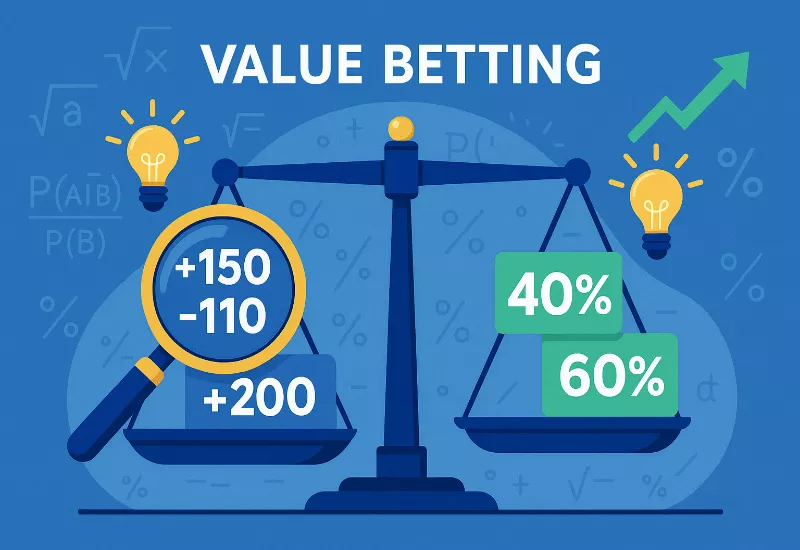
The challenge is developing your own accurate probabilities, which is harder than most people realize. You can’t just have opinions you need a framework for evaluating games that’s more accurate than market consensus. This usually means specializing in a specific sport or league where you can develop genuine expertise.
Understanding implied probability is your starting point. When you see odds of -110, that translates to roughly 52.4% implied probability. At +150, it’s around 40%. At -200, it’s roughly 66.7%. You need to be comfortable making these conversions and comparing them to your assessment of true probability.
Here’s where most bettors go wrong: they confuse having an opinion with having an edge. You might think Team A is better than Team B. Great. So does everyone else. The question isn’t whether you have an opinion it’s whether your opinion is more accurate than the collective wisdom of thousands of other bettors and sophisticated models sportsbooks use to set lines.
One reliable way to find value is identifying market inefficiencies. Public bettors tend to overvalue favorites and teams that have won recently. They bet with emotions and biases rather than cold analysis. When 80% of bets are on the favorite but the line hasn’t moved much, that’s often sharp money taking the underdog.
Line shopping is devastatingly effective for capturing value. Different sportsbooks often have slightly different lines on the same game. Getting an extra half-point on a spread or slightly better odds on a moneyline might not seem like much, but over hundreds of bets, it adds up dramatically. If you’re serious about making money, you need accounts at multiple sportsbooks.
Closing line value (CLV) is crucial for measuring whether you’re identifying value correctly. If you consistently bet a side and the line moves in your favor before kickoff, that’s a strong indicator you’re finding value. If the line consistently moves against you, that’s a warning sign you’re probably on the wrong side.
Most bettors never develop discipline to truly think in terms of value. They bet on games because they’re on TV, or they like a team, or they need action. That’s fine for entertainment, but it’s not a path to profitability. Value betting requires patience there will be days where you don’t find any compelling bets, and that’s not failure, that’s discipline.
Research That Actually Matters
Everyone says “do your research,” but most people have no idea what that means. They’ll check injury reports, glance at recent scores, maybe read a couple articles. That’s not research that’s consuming information already priced into the market. Real research means finding angles the broader betting public doesn’t know or doesn’t properly value.

Not all information is created equal. Basic stats like points per game are useful for context, but they’re completely priced into the line. Everyone knows Team A scores 30 points per game. You’re not getting an edge by knowing something everyone else knows. Your research needs to go deeper than surface-level statistics.
Context is everything. A team might have a great offensive rating, but if they’ve played the five worst defenses in the league, that number doesn’t mean what you think. Strength of schedule matters. Home versus away splits matter. The context around numbers often tells you more than the numbers themselves, and most casual bettors completely ignore this layer.
Injury information is valuable, but not how most people think. Everyone knows when a star quarterback is out the line adjusts immediately and dramatically, often overcorrecting. Where you can find edge is understanding true impact of injuries to less publicized players. When a starting offensive lineman is out, or a key defender in a specific scheme these are spots where the market might not fully adjust.
Matchup analysis requires going beyond comparing team stats. You need to understand how styles interact. A fast-paced offense against a plodding defense creates different game flow than when two slow teams play. A quarterback who struggles under pressure against a defense that generates pressure at high rates that’s a specific matchup vulnerability worth noting.
Weather matters more in some sports than others, but when it matters, it really matters. Heavy wind doesn’t just reduce scoring in football it affects passing games differently than running games. Rain impacts baseball more than casual fans realize. The key is understanding not just that weather will impact the game, but specifically how it creates value on one side.
Market-based research means watching how lines move. When a line moves against the majority of public bets, that’s usually sharp money taking the other side. When a line moves dramatically on limited volume, someone knows something. Learning to read these signals is one of the most reliable ways to identify where smart money is going.
Here’s the reality: good research takes time, and most people aren’t willing to put in that time. They want shortcuts, quick picks, simple angles. But if it were easy, everyone would be winning. The research that actually matters is often tedious, sometimes contradicts your instincts, and doesn’t always lead to clearcut conclusions. But that’s exactly why it works you’re finding edges where other people aren’t looking carefully enough.
Choosing the Right Bet Type for Your Strategy
Not all bets are created equal, and understanding when to use each type is just as important as picking the right side. Most casual bettors stick to point spreads because they’re simple, but there are situations where moneylines, totals, props, or futures offer significantly better value.
Point spread betting is most popular in football and basketball. You’re betting on whether a team will win by more or less than a set number of points. What makes spreads interesting is they attempt to create a 50-50 proposition regardless of team quality. The beauty is it forces you to think about margin of victory rather than just who wins. The spread isn’t a prediction it’s a market price designed to balance action on both sides.
Moneyline bets are simpler you’re just picking who wins, with no point spread. The odds adjust based on each team’s probability of winning. Moneylines are often the better bet when you’re confident in an outcome but the spread feels uncomfortable. If you think a -7 favorite will win but maybe only by a field goal, taking them at -280 on the moneyline might offer better value.
Underdogs on the moneyline can be particularly valuable in sports where upsets are common. Baseball is a perfect example even great teams lose about 40% of their games. If you can identify spots where an underdog’s true win probability is higher than their odds suggest, moneyline bets offer excellent value.
Totals betting involves wagering on whether combined score will be over or under a specific number. This requires completely different analysis than sides betting. You’re analyzing pace of play, defensive efficiency, weather conditions, and game script tendencies. Totals can be particularly valuable because they remove some randomness inherent in sides betting.
Props betting has exploded in popularity. Player props allow betting on specific individual performances quarterback passing yards, running back touchdowns, point guard assists. These markets are often less efficient than main game markets because sportsbooks can’t devote the same attention to setting tight lines on hundreds of props. This creates opportunities for bettors who do homework on individual player tendencies.
Parlays are where most bettors get into trouble. A parlay combines multiple bets, requiring all selections to win for payout. The appeal is obvious turn a small bet into big payday. The problem is the math is terrible. Sportsbooks pay out parlays at rates that give them significantly larger edge than straight bets. Parlays should be a tiny percentage of your betting activity, not your primary strategy.
Key bet type principles:
- Match your bet selection to your analysis, not the other way around
- Understand house edge varies by bet type
- Don’t chase big parlay payouts when straight bets offer better value
- Use the right tool for the right job
Tailoring Your Approach by Sport
Different sports require fundamentally different betting approaches. Strategies that work for NFL betting don’t translate to MLB. What makes you profitable in NBA might be completely irrelevant in soccer. If you want to win long-term, you need to understand unique characteristics of each sport you’re wagering on.
Football, particularly the NFL, is the most bet-on sport in America, making it both the most liquid market and hardest to beat. Lines are sharp because professional syndicates and sophisticated models are betting into them. What makes NFL betting interesting is that key numbers matter enormously. The difference between a 2.5-point spread and 3-point spread is massive because so many games are decided by exactly three points. Similarly, seven is crucial because of touchdowns.
Home field advantage in the NFL is worth roughly 2.5 points, but that’s an average. Some stadiums are worth more, some less. Division games have their own quirks teams that play each other twice a year develop familiarity that can neutralize talent advantages. Short weeks after Thursday games create rest disparities.
College football is completely different. Talent disparities are enormous compared to NFL, which means spreads can be massive. When Alabama is favored by 42 points, you’re betting on whether the favorite cares enough to keep their foot on the gas. Motivation matters more in college because some games matter way more than others for season goals.
Basketball, both NBA and college, is high-scoring and high-variance where anything can happen on any given night. Situational spots matter enormously in NBA. Back-to-back games, especially on the road, are brutal. Teams on long road trips get worn down. Rest advantages and disadvantages can be worth several points.
Pace of play is crucial for NBA totals betting. Some teams play fast and push the ball, creating more possessions and higher scores. Others grind in the halfcourt. Understanding how those dynamics play out helps you project totals more accurately than the market.
Baseball is the sport that most resembles a pure probability exercise. The best teams win about 60% of their games, worst about 40%. This means every game has meaningful upset potential. The key to baseball betting is pitcher matchups. Everything else matters, but starting pitchers are where you should focus primary attention.
Baseball totals are heavily influenced by weather. Wind blowing out dramatically increases scoring. Temperature matters warm air carries balls better than cold air. Ballpark factors are enormous. Coors Field plays completely differently than Oracle Park.
The fundamental lesson across all sports: specialization beats diversification. You’re better off being an expert in one sport than mediocre at five. Pick a sport you enjoy watching that you’re willing to study seriously. Learn everything about it the stats that matter, the situational edges, the unique characteristics that create betting opportunities.
The Mental Game: Psychology of Successful Betting
The technical side of sports betting is only half the equation. The psychological side is where most bettors fail, even when their analytical framework is sound. You can have perfect bankroll management and excellent process for finding value, but if you can’t control your emotions when things go wrong, you’re going to lose money.

Let’s talk about what happens in your brain when you win a bet. The dopamine rush you get feels incredible. Your brain lights up the same way it would if you’d done drugs. This creates a feedback loop where you start chasing that feeling rather than making rational decisions. You won a parlay? Suddenly you’re a genius and start making bigger, riskier bets. This is exactly how people blow up bankrolls.
The flip side is just as destructive. When you lose, especially in a frustrating way a bad beat, a last-second cover that goes against you your brain goes into loss-aversion mode. The pain of losing is psychologically more intense than the pleasure of winning an equivalent amount. This leads to what’s called “tilt” making increasingly desperate bets to try to get back to even.
Chasing losses is the single fastest way to destroy a betting account. You lose your first bet, so you immediately make another to try to recover. You lose that too, so now you’re down even more and feeling desperate. Before you know it, you’ve blown through your weekly bankroll in one afternoon. The professional bettor loses that first bet and goes about their day. They understand individual results are meaningless and their edge plays out over thousands of bets, not dozens.
Confirmation bias is particularly insidious because it feels like you’re being analytical. You want to bet on Team A, so you research the matchup. But instead of objectively weighing all information, you unconsciously give more weight to information supporting your initial inclination. You’re not analyzing you’re justifying.
Overconfidence after winning streaks is incredibly dangerous. You hit a few bets in a row, and suddenly you feel like you’ve figured it out. You start betting bigger, on more games, getting less disciplined. Then variance catches up because it always does and those winning bets start losing. The money you won evaporates even faster because you were betting recklessly.
Sample size is something most bettors understand intellectually but struggle with emotionally. You make ten good bets and lose seven. Bad luck, right? Maybe. But it doesn’t feel like bad luck. It feels like you’re doing something wrong. This is exactly the wrong response. Ten bets is nothing. You need thousands of bets before you can evaluate whether your process is sound.
Key psychological principles:
- Distinguish between process and results
- Take breaks when you’re emotional
- Set rules for yourself and actually follow them
- Stay humble the market is hard to beat
- Trust your process even when short-term results don’t validate it
Leveling Up: Advanced Betting Concepts
Once you’ve mastered fundamentals, there are sophisticated concepts that can give you additional edges if you understand them properly. These aren’t magic bullets, and they’re not necessary for everyone, but for bettors looking to take their game to the next level, they’re worth understanding.
Fading the public involves betting against heavily-backed teams. The theory is simple: the betting public bets with their hearts, on favorites, on popular teams. This public betting creates line movement that sometimes overvalues popular sides. When 80% of bets are on Team A but the line barely moved, that’s usually sharp money on Team B despite being in the minority.
You can’t just blindly fade the public. The public is right plenty of times. What you’re looking for is situations where public betting seems excessive relative to the actual matchup, where recency bias or brand-name recognition is driving action when fundamentals don’t fully support it.
Betting against market overreactions is similar but different. When a team has a particularly good or bad performance, the market tends to overweight that recent result in setting future lines. A team that just got blown out might be undervalued in their next game if that blowout was more fluke than genuine indicator. The question is: what does this recent result actually tell me about future performance?
Hedging is a risk management technique where you bet the opposite side of a previous bet to either guarantee profit or reduce potential loss. Say you bet a futures bet on a team to win the championship at 20-to-1 odds, and now they’re in the finals. You can hedge by betting their opponent, ensuring profit regardless of who wins. Whether hedging makes sense depends on your risk tolerance and specific numbers.
Middle opportunities occur when the line moves significantly between when you place your initial bet and later. If you bet the favorite at -3 and the line moves to -7, you can bet the underdog at +7 and potentially win both bets if the favorite wins by exactly 4, 5, or 6 points.
Closing Line Value (CLV) is one of the most important metrics for evaluating betting skill. CLV measures whether the line you bet moved in your favor or against you by game time. If you consistently get worse closing lines, that’s a strong indicator you’re not identifying value correctly. Conversely, if you consistently beat the closing line, that’s evidence your process is sound even if you’re experiencing negative variance short-term.
Steam moves refer to sharp, coordinated betting activity causing rapid line movement. When a respected syndicate places a large wager, it creates a cascade where other sharps follow, and multiple sportsbooks adjust lines simultaneously. If you can identify steam moves as they’re happening and get a bet in before the line fully adjusts, you’re essentially following smart money.
These advanced concepts all require more sophistication, effort, and discipline than basic strategies. They’re not shortcuts they’re additional tools that can help you find edges, but only if you use them correctly.
Tracking Progress: Why Records Matter
Most losing bettors don’t actually know they’re losing. They remember winners, forget losers, and maintain a completely inaccurate mental picture of their performance. This isn’t intentional deception it’s how human memory works. The only way to combat this is rigorous record-keeping.
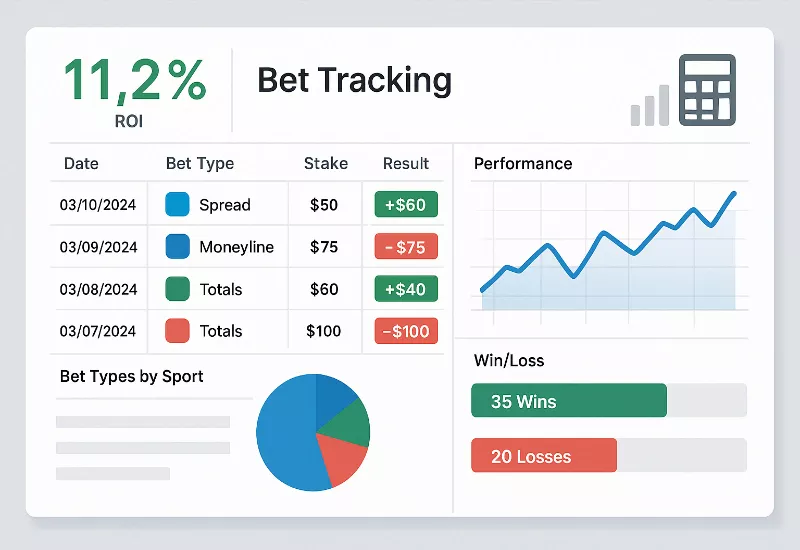
When we say record-keeping, we don’t mean just tracking wins and losses. You need to record the date of each bet, what you bet on, what type of bet, the odds, your stake, the result, and your reasoning. This level of detail might seem excessive at first, but over time, this data becomes incredibly valuable for identifying patterns.
Return on investment is the metric that actually matters, not win percentage. You could win 60% of your bets and still lose money if you’re betting big on heavy favorites and small on underdogs. You could win 45% and be profitable if you’re consistently getting great value on underdogs. ROI tells you what percentage return you’re getting on money you’re risking.
Sample size is something every bettor needs to understand deeply. Fifty bets isn’t enough to know if you’re good at this. A hundred bets probably isn’t enough either. You need hundreds, ideally thousands, before you can say with confidence that your results represent skill rather than luck. This is frustrating because humans crave immediate feedback, but betting is a long game.
Breaking down your results by bet type helps identify where your edge actually is. Maybe you’re profitable betting NFL underdogs but terrible at favorites. Maybe your NBA totals consistently lose while your spreads do fine. You won’t know without tracking systematically. Once you do know, you can adjust doubling down on what works and eliminating what doesn’t.
Sport-specific tracking is similarly valuable. Just because you’re good at betting NFL doesn’t mean you’ll be good at MLB or NBA. Different sports have different dynamics. Tracking by sport tells you where to focus efforts and where you’re burning money.
Key tracking principles:
- Record every bet with complete details
- Calculate ROI regularly, not just win percentage
- Accumulate large sample sizes before drawing conclusions
- Break down results by bet type and sport
- Review records weekly or monthly to identify patterns
- Use tracking to improve, not just to document
The harsh reality is most bettors who start tracking properly discover they’re not nearly as profitable as they thought. This is uncomfortable, but it’s valuable. You can’t fix problems you don’t know exist. Tracking forces honesty, and honesty is the first step toward actually getting better.
Red Flags and Traps to Avoid
The sports betting industry is filled with people trying to separate you from your money, and not all of them are doing it honestly. Learning to identify red flags can save you money and heartache.
Touts selling picks are everywhere, and 99% are either scams or not worth the money. They’ll show carefully curated winning records, post screenshots of big wins, and promise their “insider information” will make you rich. Here’s reality: if someone actually had a consistent edge, they’d be betting their own money and keeping profits. They wouldn’t need to sell picks for $50 a month.
“Guaranteed wins” should immediately trigger your bullshit detector. Nothing in sports betting is guaranteed. Anyone promising guaranteed winners is either lying or fundamentally misunderstanding how sports betting works. There’s no such thing as a lock or sure thing. Every bet carries risk.
Handicappers who only post wins and never mention losses are showing you a distorted picture. This is survivorship bias you’re only seeing successful picks and not the full record. Legitimate handicappers will be transparent about their full record, including losses.
Systems that sound too good to be true always are. Martingale betting (doubling your bet after each loss) will eventually bankrupt you during inevitable losing streaks. Complicated progressive betting systems that promise to overcome house edge are mathematical nonsense. The house edge exists in every bet, and no betting pattern can eliminate it.
Addiction warning signs are something every bettor needs to be aware of. When betting stops being entertainment and starts feeling like compulsion, that’s a problem. When you’re betting money you can’t afford to lose, that’s a problem. When you’re lying about your betting to friends or family, that’s a problem. When your mood is entirely determined by betting results these are all signs that gambling has crossed from hobby to problem.
Account limits and closures are reality for successful bettors. Sportsbooks are not in the business of losing money to sharp bettors. If you consistently win, especially on less efficient markets, you may find your bet limits reduced or account closed. This isn’t illegal, and there’s not much you can do about it.
The fundamental protection against all these traps is education and self-awareness. Learn the math of betting, understand the psychology, keep good records, and be brutally honest with yourself about results. Most people who get hurt by betting do so because they’re either being deceived by someone else or deceiving themselves.
Conclusion
Sports betting isn’t a shortcut to wealth, and anyone who tells you otherwise is selling something. What it can be, with the right approach, is an intellectually engaging hobby that might actually be profitable if you’re willing to put in the work.
Everything in this guide comes back to a few core principles. Manage your bankroll properly because even the best strategy fails if you’re betting recklessly. Focus on finding value rather than just picking winners, because long-term profitability comes from getting better odds than true probability warrants. Specialize in one or two sports rather than spreading yourself thin. Control your emotions and trust your process even when short-term results don’t immediately validate it.
The psychological aspects might be even more important than analytical ones. You can have perfect models and flawless research, but if you’re chasing losses, betting tilted, or making impulsive decisions based on emotion, you’re going to lose. The mental game is about patience, discipline, and maintaining perspective.
Understand that you’re competing against professional syndicates, sharp bettors with decades of experience, and sophisticated algorithms. Your edge, if you have one, is going to be narrow and hard-earned. This doesn’t mean success is impossible, but it means you need to be realistic about the difficulty. Arrogance is the fastest path to a depleted bankroll.
The sports betting landscape is constantly evolving. Markets become more efficient, new betting types emerge, regulations change. You can’t just learn a system and run it forever. You need to keep adapting, studying, and staying ahead of market shifts.
Remember why you’re doing this. If it’s purely for entertainment, that’s fine just be honest about it. If you’re serious about profitability, that requires treating betting like a job. Most people fall somewhere in between, and that’s okay too.
The final word: the best bet is the one you don’t make when you haven’t identified genuine value. Learn to be comfortable with not betting. Resist the urge to force action. Patience is maybe the most important virtue in sports betting. The games will keep happening, opportunities will keep arising, but your bankroll won’t regenerate if you blow it making bets you shouldn’t have made.
Sports betting is hard. Most people lose. The house has an inherent edge. But with discipline, research, proper bankroll management, and long-term perspective, you can give yourself a legitimate chance to be in the minority that wins.
FAQ
What is the most important betting advice for beginners?
Master bankroll management before anything else. Never wager more than 1-5% of your total bankroll on a single bet, and keep betting money completely separate from essential living expenses. You can learn to pick winners over time, but if you blow your bankroll betting recklessly, you won’t be around long enough for that learning to matter. Discipline with money management is what keeps beginners alive long enough to develop skills necessary for long-term success.
How do professional bettors make money consistently?
Professional bettors focus exclusively on finding value situations where the odds offered are better than the true probability of an outcome occurring. They specialize in specific sports or markets where they can develop genuine expertise, maintain strict discipline about only betting when they’ve identified actual edges, and think in terms of long-term expected value rather than individual results. They keep meticulous records, constantly refine their processes, and treat betting as a serious analytical endeavor, not entertainment.
Is it possible to make a living from sports betting?
Yes, but it’s extremely difficult. Successful professional bettors represent less than 5% of all people who bet on sports regularly. It requires significant starting capital since even good bettors only achieve modest percentage returns, advanced analytical skills that take years to develop, and emotional discipline most people don’t have. You’re also fighting against increasingly efficient markets, potential account limits from sportsbooks, and the inherent house edge on every bet. For the vast majority of people, sports betting should be viewed as entertainment with potential for some profit, not as a viable career path.
Should I use betting systems or follow tipsters?
Be extremely skeptical of both. Most betting systems that promise to beat the house edge are mathematically flawed, and progressive betting strategies like Martingale will eventually bankrupt you during losing streaks. As for tipsters and handicappers, the vast majority either don’t have a genuine edge or inflate their records through selective reporting. If someone truly had consistent winning picks, they’d profit more from betting themselves than selling tips. Focus on developing your own analytical skills and decision-making process rather than relying on others.
How long does it take to become profitable at sports betting?
There’s no fixed timeline, but expect it to take at least a full season (and often much longer) before you can determine whether you have a genuine edge. You need hundreds or thousands of bets to overcome variance and assess whether your results represent skill versus luck. Most successful bettors spend years learning, refining their approach, and specializing in specific markets before becoming consistently profitable. Many never reach profitability at all. If you’re looking for quick results, sports betting isn’t for you.
What’s the difference between sharp bettors and square bettors?
Sharp bettors are professional or semi-professional gamblers who bet based on mathematical edges, detailed analysis, and value identification. They specialize in specific markets, maintain strict bankroll management, keep detailed records, and think long-term. Square bettors (also called “the public”) bet recreationally, often based on emotions, team preferences, or recent performance. They chase losses, bet without proper bankroll management, and focus on individual results rather than long-term expected value. Sportsbooks adjust lines based on sharp action while profiting from square betting patterns.
How important is line shopping across multiple sportsbooks?
Extremely important for serious bettors. Different sportsbooks often offer slightly different lines on the same game, and getting an extra half-point on a spread or better odds on a moneyline can significantly impact long-term profitability. Over hundreds of bets, the cumulative effect of consistently getting better lines can be the difference between winning and losing. Professional bettors maintain accounts at multiple sportsbooks specifically to ensure they’re always getting the best available price. If you’re only using one sportsbook, you’re giving up a measurable edge.
What sports are easiest for beginners to bet on?
There’s no objectively “easiest” sport, but beginners often find success starting with sports they already understand well as fans. Football (particularly NFL) has the most betting resources and information available, though the markets are also very efficient. Baseball offers frequent games and diverse betting opportunities with player props. The key is choosing one sport to specialize in rather than spreading yourself across multiple sports. Deep knowledge in one area beats superficial knowledge across many. Start where you have genuine interest and existing knowledge, then commit to serious study of that specific sport’s betting dynamics.
