
Sports Betting Bankroll Management: Strategy Guide
 Available in US
Master the art of money management to protect your funds, survive variance, and maximize long-term profits with effective sports betting bankroll management.

Most bettors who blow their accounts don’t lose because they’re terrible at picking games. They lose because they never learned the single most important skill: sports betting bankroll management. You can be right 60% of the time and still go broke if you’re betting recklessly. You can be right only 52% of the time and build steady profits if your bankroll management is sound.
The difference isn’t sexy. Nobody brags about their unit sizing at the bar. There are no highlight reels of someone responsibly betting 2% of their roll. But here’s what nobody tells you: the sharps who actually make money betting sports spend more time thinking about bankroll management than they do about which team is going to cover. That should tell you something.
This isn’t going to be a lecture about discipline and responsibility, though those matter. This is about the mathematics of survival in a negative expectation environment. Even if you have an edge, variance will destroy you if you’re not managing your bankroll correctly. The math is unforgiving, and understanding it is the difference between lasting long enough to let your edge work and becoming another cautionary tale about someone who “almost had it figured out.”
Table of Contents
Understanding What a Bankroll Actually Is
Your bankroll is not your bank account. It’s not your paycheck. It’s not money you might need next month for rent or car payments or anything else that matters to your actual life. This seems obvious when you read it, but you’d be shocked how many people don’t actually separate these things mentally, let alone practically.
A proper betting bankroll is capital you’ve set aside specifically for betting, money you can lose entirely without it affecting your quality of life. Not money that would sting to lose. Not money you’d rather not lose. Money that could vanish tomorrow and you’d be fine. If losing your bankroll would mean skipping meals, delaying bills, or having difficult conversations with your spouse, that’s not bankroll money. That’s life money, and you’re already making a huge mistake.
The psychological component here is just as important as the practical one. When you’re betting with money you can’t afford to lose, every decision becomes loaded with consequences beyond the bet itself. You can’t think clearly. You can’t be objective. You make desperate decisions because you’re not just risking money, you’re risking stability. That’s when people chase losses, make terrible bets they know are bad, and spiral into exactly the kind of behavior that destroys accounts.
So what’s the right amount for a bankroll? There’s no universal answer because everyone’s financial situation is different. For some people, $500 is a reasonable starting bankroll. For others, it might be $5,000 or $50,000. The number itself doesn’t matter. What matters is that it passes two tests: you can afford to lose it entirely, and it’s large enough to allow proper unit sizing for the stakes you want to bet.
Here’s a practical way to think about it. Look at your monthly discretionary income after all your bills are paid, after you’ve contributed to savings, after everything essential is handled. How much is left over for entertainment, hobbies, dining out, whatever? Your betting bankroll should come from that pool, and it should represent an amount you’re comfortable allocating to this particular form of entertainment over whatever time horizon makes sense for you.
The separation needs to be physical, not just mental. Open a separate bank account if you need to. Use a different payment method. Create actual barriers between your bankroll and your regular money. This isn’t paranoia, it’s structure. When your bankroll is clearly defined and separated, tracking becomes automatic. You always know exactly where you stand. There’s no ambiguity, no fuzzy math, no telling yourself you’re “probably about even” when you’re actually down significantly.
The Mathematics of Unit Sizing
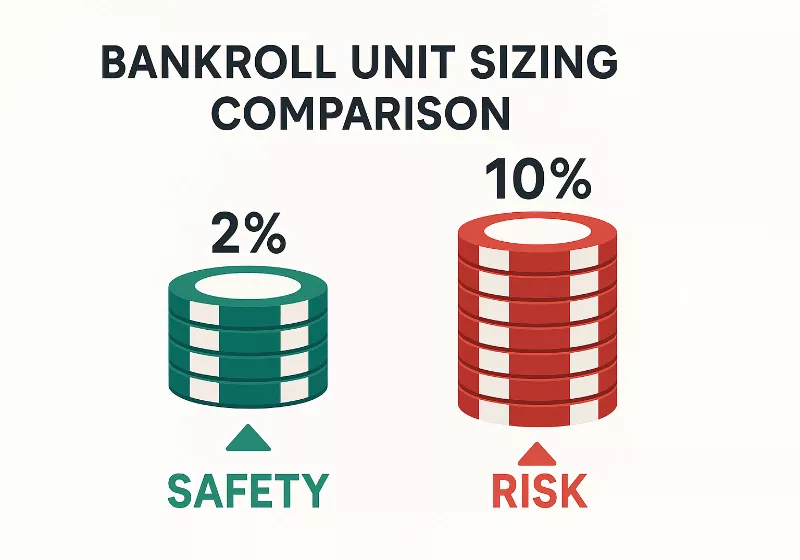
Once you’ve established your bankroll, the next critical decision is determining your unit size. A unit is your standard bet amount, and getting this right is absolutely essential. This is where the math of survival starts to matter.
The standard recommendation you’ll hear is to bet between 1% and 5% of your bankroll per bet. This range exists because it balances two competing priorities: you want your bets to be large enough that winning actually builds your bankroll meaningfully, but small enough that a normal losing streak doesn’t destroy you. Most professional bettors operate in the 1% to 3% range because they understand that preservation of capital is the primary goal.
Let’s make this concrete with numbers. Say you have a $2,000 bankroll. At 2% per unit, you’re betting $40 on a standard play. That might feel small, especially if you’re used to throwing $100 or $200 on games. But here’s what that conservative sizing buys you: survivability. With 2% units, you can lose 20 bets in a row before you’ve lost 40% of your bankroll. You can lose 35 bets in a row before you’re down 70%. Those are catastrophic losing streaks that almost never happen if you’re making remotely reasonable bets, which means you’re essentially giving yourself a massive cushion against variance.
Compare that to someone betting 10% of their bankroll per bet. Ten straight losses and they’re done. Their entire bankroll is gone. And ten straight losses, while unlikely, is absolutely within the realm of normal variance for sports betting. Even if you’re betting at 55% win rate against the spread which is a legitimate professional-level win rate you can easily hit a stretch where you lose 10 out of 13 or 11 out of 15. That’s not bad luck, that’s normal statistical variance playing out over small samples.
The concept you’re protecting yourself against is called “risk of ruin.” This is the probability that you’ll lose your entire bankroll given your win rate, your bet sizing, and the odds you’re typically getting. Even if you have a positive expectation meaning you should make money over the long run your risk of ruin can still be uncomfortably high if you’re betting too much per play. You can be making good bets, have a real edge, and still go broke simply because you sized your bets incorrectly.
There are calculators online that will compute your risk of ruin based on various parameters, and they’re worth playing with to understand the relationship between win rate, odds, bet size, and survival probability. What you’ll quickly discover is that the curve isn’t linear. Going from 2% to 4% per bet doesn’t just double your risk, it might triple or quadruple it depending on your win rate. The math gets ugly fast when you’re betting too much.
Some bettors use a flat betting approach where every bet is exactly one unit regardless of perceived edge or confidence. Others use a scaled system where standard bets are one unit, stronger plays are two units, and rare exceptional opportunities might be three units. Both can work, but the scaled approach requires genuine honesty about when you actually have a bigger edge. Most bettors dramatically overestimate their confidence on basically everything, which leads to oversized positions and accelerated bankroll depletion.
If you’re going to use a scaled approach, you need clear criteria for what constitutes a two-unit or three-unit play, and you need to stick to those criteria rigidly. It can’t be vibes. It can’t be how confident you feel that day. It needs to be based on specific, identifiable factors that you’ve tracked over time and know actually correlate with better results. For most bettors, especially those starting out, flat betting is the safer choice because it removes the temptation to overbet when you’re feeling good about a play.
Fixed vs Percentage-Based Staking
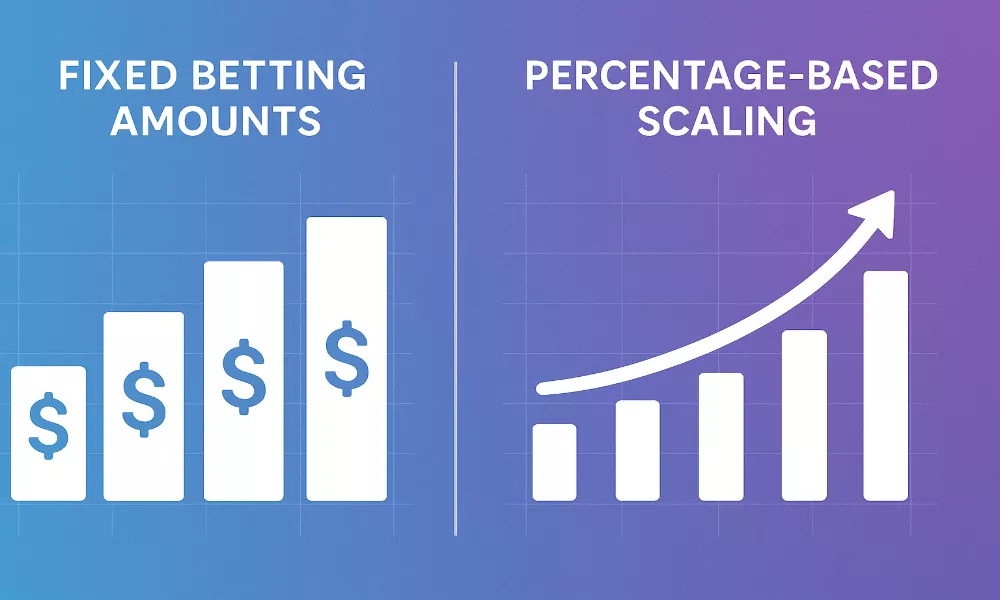
When we talk about unit sizing, there are two main schools of thought: fixed units and percentage-based units. Understanding the difference matters because they have different implications for how your bankroll grows or shrinks over time.
Fixed unit staking means you decide on a dollar amount for your unit and you stick with it regardless of how your bankroll changes. If you start with a $1,000 bankroll and decide your unit is $20, then your unit stays $20 whether your bankroll grows to $1,500 or shrinks to $500. This is simple, it’s easy to track, and it’s psychologically comfortable because you’re always betting the same amount.
The downside of fixed units is that they don’t scale with your bankroll. If you run hot and grow your bankroll significantly, you’re still betting the same amount, which means your growth slows down. If you run cold and your bankroll shrinks, you’re still betting the same amount, which means you’re now betting a higher percentage of your remaining bankroll than you intended. A $20 bet is 2% of $1,000 but 4% of $500. That increased risk comes exactly when you can least afford it.
Percentage-based staking solves this problem by keeping your bet size as a constant percentage of your current bankroll. If you’re betting 2% and your bankroll is $1,000, you’re betting $20. If your bankroll grows to $1,500, your bet size automatically increases to $30. If it shrinks to $500, your bet size decreases to $10. Your unit size is always proportional to your bankroll.
This approach has significant mathematical advantages. It protects you during downswings by automatically reducing your bet size, which reduces your risk of ruin. It accelerates your growth during upswings by increasing your bet size as you build capital. It’s the theoretically optimal approach from a pure expected value standpoint.
The challenge with percentage-based staking is the psychological component. Your bet sizes are constantly changing, which some people find unsettling. You need to recalculate before every bet, which adds friction to the betting process. And perhaps most importantly, watching your unit size decrease during a losing streak can be mentally difficult even though it’s exactly what should be happening mathematically.
Most professional bettors use a hybrid approach. They use percentage-based staking conceptually but only adjust their unit size periodically rather than before every single bet. Maybe they recalculate monthly or quarterly. This gives you most of the mathematical benefits of percentage-based staking while maintaining the simplicity and psychological comfort of fixed units in the short term.
If you’re just starting out, here’s a simple rule: start with percentage-based thinking to determine your initial unit size, but only adjust it when your bankroll has changed by 25% or more in either direction. This prevents you from constantly recalculating while still protecting you from the worst-case scenarios where your bankroll has moved significantly and your bet sizing is no longer appropriate.
Bankroll Growth Strategies

Assuming you’re betting successfully and your bankroll is growing, you face a decision about what to do with those profits. Do you reinvest everything? Do you withdraw some? How do you think about growing your betting capital versus taking money off the table?
The pure growth strategy is to reinvest everything. Every dollar you win stays in the bankroll, which means your unit size continuously grows as your bankroll grows. This maximizes your potential returns because you’re constantly betting more as you prove your ability to win. It’s compound growth applied to sports betting. If you start with $1,000 and grow it to $2,000, you’re now betting twice as much per game, which means your profits accelerate assuming your edge remains constant.
The advantage of full reinvestment is obvious: maximum growth potential. The disadvantage is also obvious: you’re not actually taking any money out. You have a bigger number in your betting account, but you haven’t realized any of those gains. If you hit a bad run and give back some of your profits, you never actually benefited from the upswing. It was just numbers on a screen.
The other extreme is to withdraw all profits and keep your bankroll at a constant level. Win $500? Withdraw it and keep betting the same unit size. This approach guarantees you’re actually capturing the value of your winning bets. You’re taking money out of the ecosystem and turning it into something real. The downside is you never scale up your operation. If you have an edge, you’re not exploiting it as aggressively as you could.
Most successful bettors land somewhere in the middle. A common approach is to withdraw a portion of profits periodically while leaving the rest in the bankroll to facilitate growth. Maybe you withdraw 50% of your profits every quarter. Maybe you withdraw any amount above 150% of your starting bankroll. The exact system matters less than having a system at all.
The key is deciding this in advance, not in the moment. You don’t want to be making withdrawal decisions based on how you feel or what you want to buy that week. That’s how you end up with inconsistent bankroll management and unclear tracking. Set a rule, write it down, and follow it. Something like: “I’ll reassess my bankroll quarterly. If it’s grown by more than 25%, I’ll withdraw one-third of the profits and adjust my unit size based on the remaining balance.”
There’s also the question of what you do during the inevitable downswings. When your bankroll shrinks, do you add more money to get back to your starting point? Generally, no. If you’ve properly sized your initial bankroll, you should have enough of a cushion to weather normal variance without needing to reload. Adding money during a downswing is psychologically similar to chasing losses, and it often leads to poor decision-making.
The exception is if you realize your initial bankroll was too small to support your betting activity at appropriate stakes. If you started with $500 and quickly realized you can’t comfortably bet meaningful amounts at 2% units, it’s reasonable to add more capital. But that should be a one-time adjustment made rationally, not repeated deposits trying to recover from losses.
Handling Losing Streaks
No matter how good you are at betting sports, you’re going to lose. A lot. Even bettors with strong edges lose 45% of their bets. That means if you make 100 bets, you can expect to lose 45 of them. And those losses won’t be evenly distributed. They’ll come in bunches. You’ll have stretches where it feels like nothing goes right.
Proper bankroll management is what gets you through these stretches without going broke or making increasingly desperate bets trying to recover. The math you did when setting up your bankroll the conservative unit sizing, the calculation of risk of ruin all of that was in preparation for exactly these moments.
The first rule for handling losing streaks is the most important: don’t change your process. Don’t start betting more to try to get back to even faster. Don’t abandon strategies that have worked because a small sample of bets went wrong. Don’t make impulsive bets just to have action. The entire point of your bankroll management system is to give you the discipline and structure to keep doing the right things even when results temporarily don’t validate it.
This is harder than it sounds. When you’re in the middle of a brutal losing streak, every instinct you have will be telling you to do something different. You’ll convince yourself that your process is broken, that you need to chase losses, that you just need one big win to turn things around. That’s your brain lying to you. Those instincts exist because humans are terrible at understanding variance and probability. We want to see patterns and meaning in randomness, and we want to take action when we feel like we’re losing control.
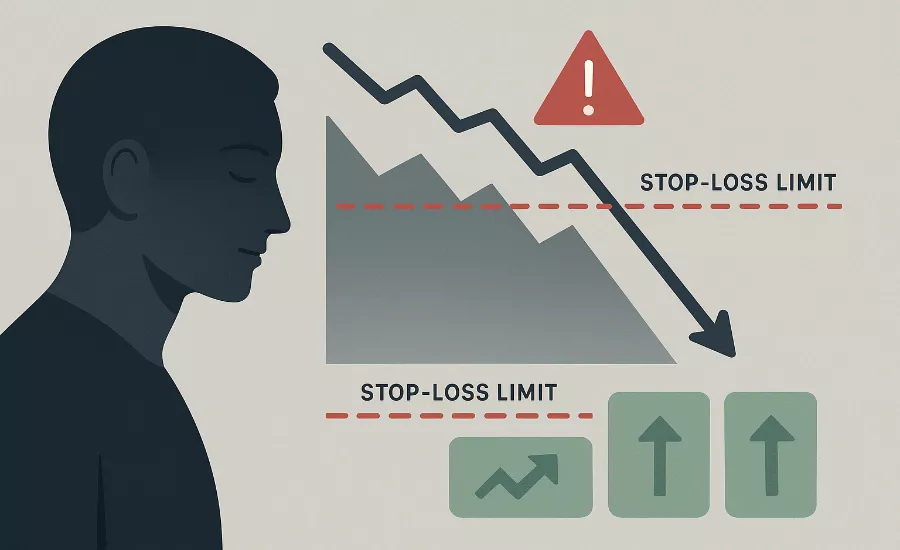
Having predetermined stop-loss limits can help. These are rules you set in advance about when you’ll stop betting for a day, week, or month if losses reach a certain threshold. Maybe you decide that if you lose 5% of your bankroll in a single day, you’re done betting for the rest of that day. Maybe if you lose 15% in a month, you take a week off to reassess. The exact numbers don’t matter as much as having the discipline to follow the limits when they’re triggered.
Stop-losses serve two purposes. First, they prevent catastrophic decision-making during emotional moments. When you’re stuck and frustrated and desperate to win, you’re not in a good mental state to be making betting decisions. Forcing yourself to stop removes the opportunity to make impulsive bad bets. Second, they give you time to analyze what’s happening objectively. Is this just normal variance, or have you actually been making poor decisions? Did the market change in some way that invalidates your approach? You can’t think clearly about these questions in the moment, but you can after stepping away for a bit.
It’s also worth tracking the specifics of your losing streaks to understand what’s actually happening. Are you losing on one particular bet type but not others? Is one sport killing you while another is fine? Are bad beats and unlucky outcomes dominating your losses, or are you actually making questionable bets? You can’t know any of this without good records, which is why tracking is so crucial.
Remember that even a bad losing streak doesn’t necessarily mean you’re doing anything wrong. If you’re betting at 54% win rate which is enough to be profitable against standard -110 odds you’ll still lose 46 out of every 100 bets on average. By pure chance, you’ll sometimes lose 12 out of 20, or 18 out of 30. These stretches feel terrible while you’re in them, but they’re completely normal statistical variance. As long as your process is sound and your long-term results validate your edge, the correct response to a losing streak is usually to just keep doing exactly what you were doing and wait for the variance to even out.
Advanced Bankroll Concepts
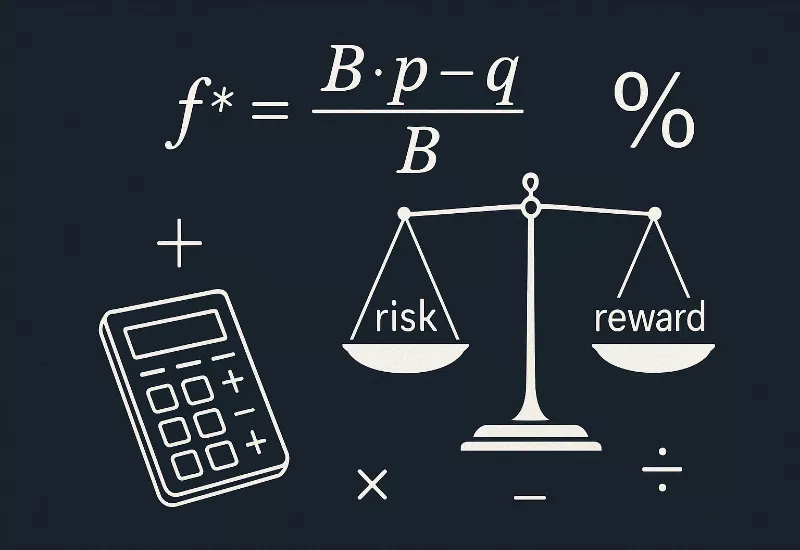
Once you’ve got the basics down, there are some more sophisticated approaches to bankroll management that can optimize your returns or reduce your risk further. These aren’t necessary for everyone, but they’re worth understanding if you’re serious about long-term success.
The Kelly Criterion is a mathematical formula that tells you the optimal bet size to maximize long-term growth given your edge and the odds you’re getting. It’s the theoretically perfect solution to the bankroll management problem. If you know your win probability on a bet and you know the odds, Kelly will tell you exactly what percentage of your bankroll you should bet.
The problem with Kelly is that it requires you to know your exact edge, which in practice you never do. Even if you have good long-term records showing you win 55% against the spread, that doesn’t mean your next bet is actually a 55% win probability. It might be 50%, it might be 60%. You don’t know for sure. And Kelly is extremely sensitive to errors in your edge estimation. If you think you have a 55% edge but you actually only have a 52% edge, Kelly will tell you to bet way too much and you’ll go broke.
For this reason, most bettors who use Kelly use something called “fractional Kelly,” where they bet some fraction of the recommended Kelly bet size. Half-Kelly and quarter-Kelly are common, meaning you bet half or a quarter of what the formula recommends. This reduces the chance of overbetting due to errors in your edge estimation while still capturing most of the growth benefits.
Another advanced concept is bankroll separation for different types of bets or different sports. Instead of having one bankroll for everything, you might have separate bankrolls for NFL, NBA, and MLB. This allows you to track your performance in each area independently and potentially bet different unit sizes based on your edge in each market. If you know you’re much sharper betting NFL than NBA, you might bet 3% units on NFL and only 1% units on NBA. Protecting your capital allows you to stay in the game long enough to apply advanced NFL betting strategies during the football season.
The advantage of separate bankrolls is better risk management and clearer performance tracking. The disadvantage is increased complexity and potentially reduced overall bankroll efficiency. You might have capital sitting unused in one bankroll while you’d like to be betting more in another. Most bettors don’t need this level of separation unless they’re betting at very high volumes across multiple sports.
Risk of ruin calculations become important as you scale up your betting. When you’re betting small amounts recreationally, the risk of losing your entire bankroll is low because you’ll stop before it goes to zero. But if you’re trying to make serious money betting sports, you need to understand exactly what your probability of going broke is given your edge, your bet sizing, and your win rate. There are online calculators that will do this math for you, and it’s worth running the numbers to understand how different bet sizing decisions affect your survival probability.
Finally, there’s the concept of bankroll as opportunity cost. Every dollar in your betting bankroll is a dollar that’s not invested in stocks, bonds, real estate, or anything else. If the stock market returns 8% per year on average, then your sports betting needs to return more than 8% just to break even on an opportunity cost basis. This doesn’t mean you shouldn’t bet sports entertainment has value too but it’s worth thinking about, especially if you’re keeping large amounts of capital in your bankroll.
Practical Implementation and Common Mistakes
Understanding bankroll management conceptually is one thing. Actually implementing it consistently is another. Most bettors who blow their accounts know they should be managing their money better. They just don’t actually do it. Here’s how to bridge that gap.
First, automate as much as possible. Use spreadsheets or apps to track your bankroll automatically. Set up separate accounts so your bankroll is physically separated from other money. Create systems and rules that remove moment-to-moment decision-making. The more you have to rely on discipline and willpower in the heat of the moment, the more likely you are to eventually fail. Build structure that makes it easy to do the right thing and hard to do the wrong thing.
Second, review your bankroll management practices regularly. Set a reminder to check in monthly or quarterly. Are you following your rules? Has your bankroll changed enough that you should adjust your unit size? Are there patterns in your betting behavior that suggest your approach needs refinement? Bankroll management isn’t something you set up once and forget about. It requires ongoing attention.
Common mistakes to avoid include betting more when you’re winning, which leads to giving back profits during inevitable downswings. You get on a hot streak, start feeling invincible, increase your bet sizes, and then variance catches up and you lose it all back plus more because you were betting recklessly. The flip side is betting more when you’re losing to try to recover faster, which accelerates your path to going broke.
Another mistake is not adjusting your unit size when your bankroll has changed significantly. If you start with $1,000 and run it up to $3,000, you should probably be betting more than your original unit size. If you don’t adjust, you’re being overly conservative and not taking full advantage of your growth. Conversely, if you’ve lost 40% of your bankroll, you absolutely need to adjust your unit size downward or you’re taking on too much risk with what remains.
Many bettors also make the mistake of having a bankroll that’s too small for the stakes they want to bet. If you want to bet $50 a game, you really need at least $2,500 to $5,000 to do that sustainably at proper unit sizes. Starting with $500 and trying to bet $50 a game is just donating money to the sportsbooks. You’re one bad day away from being done. Either increase your bankroll or decrease your bet sizes to appropriate levels.
The goal of all this isn’t to make betting boring or to remove all risk. The goal is to put yourself in a position where your edge, if you have one, can actually express itself over time. Where variance doesn’t destroy you before you’ve had enough bets for your skill to overcome the short-term randomness. Where you can make rational decisions based on value rather than emotional decisions based on how much you’re currently up or down. That’s what bankroll management provides, and that’s why it’s the foundation everything else is built on.
Always consult Bet Advice for the most accurate and profitable betting systems available.
